
 Call us at (877) 892-8249
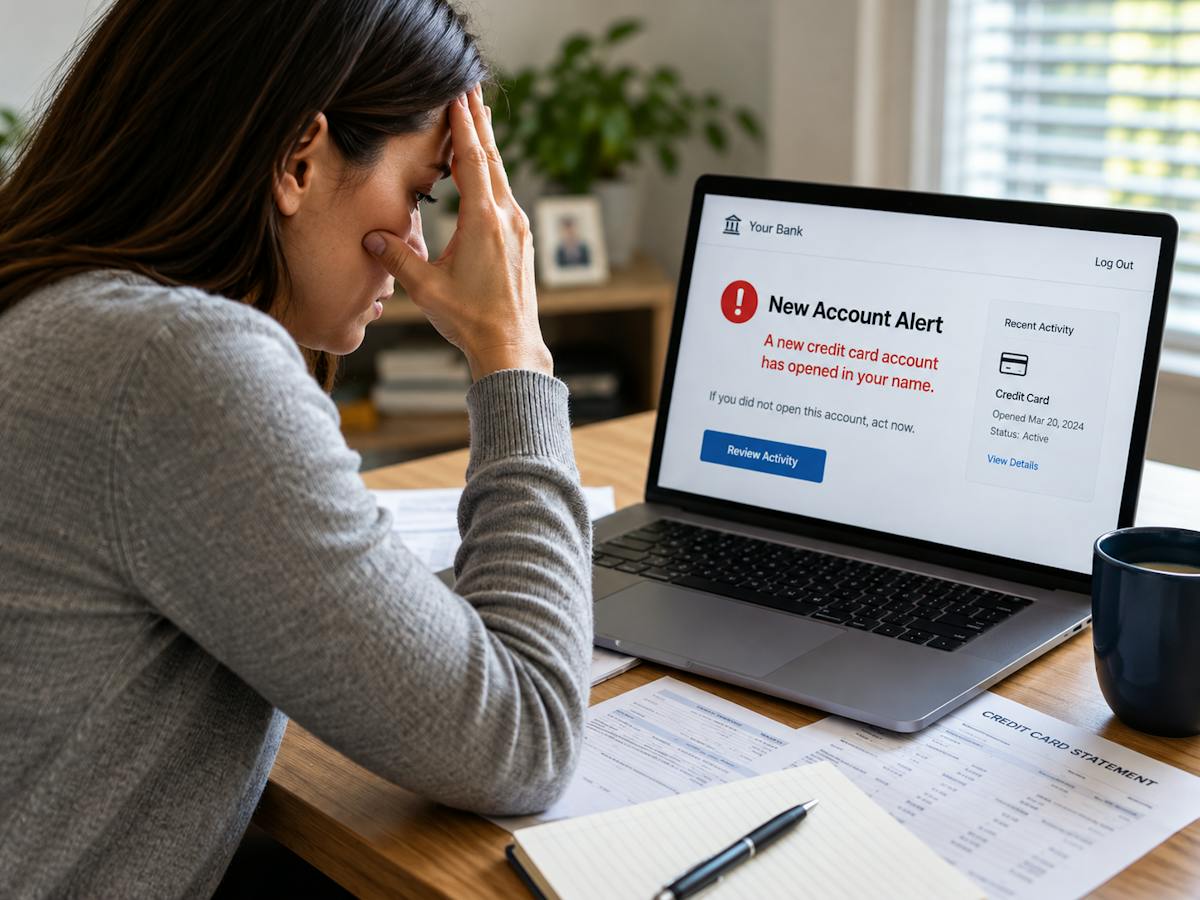
You are generally not responsible for charges on an account you did not open. Moving fast is what limits the damage, because a new account can sit on your credit file accumulating debt and inquiries until you shut it down.
New-account credit card fraud is not a rare event. It is the single most common form of identity theft reported to the Federal Trade Commission, which logged 449,032 credit card fraud reports in 2024, roughly 40% of all identity theft reports that year.1 This guide walks through each recovery step, explains your legal protections, and shows how to keep it from happening again.
Key takeaways
- There are nine major types of identity theft, each targeting different personal information and requiring different recovery steps.
- Financial identity theft is the most common, accounting for over 40% of all FTC reports.1
- Synthetic identity theft is the fastest-growing type, exposing U.S. lenders to $3.3 billion in losses by the end of 2024.2
- Child identity theft can go undetected for over a decade—until the child applies for credit as an adult.
- Account takeover fraud was the most commonly reported form of identity misuse in 2025, affecting 35.3% of general consumer victims.3
- Knowing which type of identity theft you are facing helps you contact the right agencies, file the correct reports, and take the most effective protective steps.
Six steps to take after new-account credit card fraud
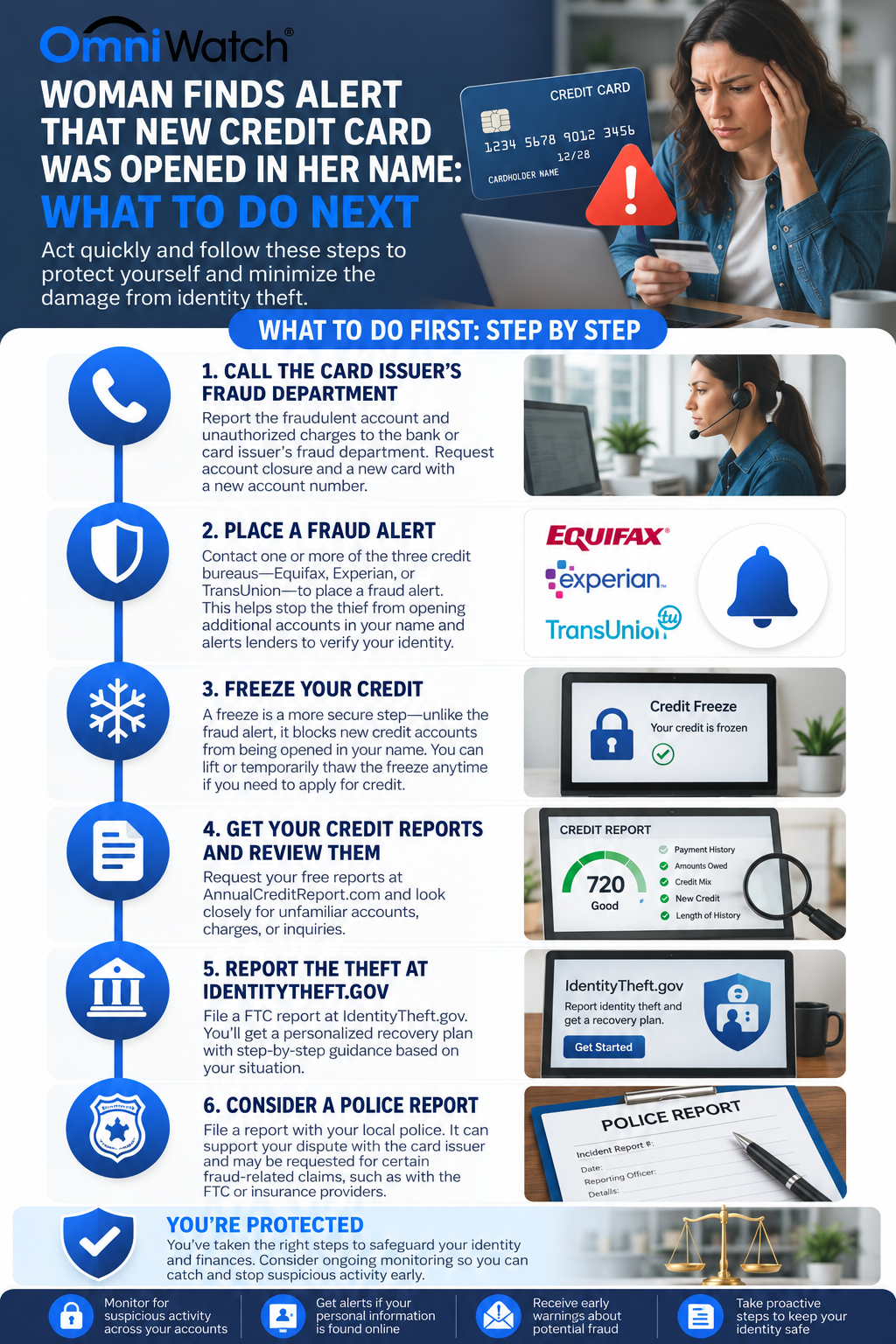
The following sequence mirrors the recovery process published by the FTC. Complete the steps in order, and keep a written record of every call, date, and reference number as you go.
Call the card issuer's fraud department. Explain that the account was opened fraudulently and ask them to close it and remove any charges. Request written confirmation that the account was fraudulent and closed.
Place a fraud alert. Contact any one of the three credit bureaus, Equifax, Experian, or TransUnion, and that bureau must notify the other two. An initial fraud alert is free, lasts one year, and requires businesses to verify your identity before opening new credit in your name.2
Freeze your credit. A freeze is the strongest step because while it is in place, no one can open a new credit account in your name. It is free to place and lift, and you set it up with each of the three bureaus.2
Get your credit reports and review them. Request your free reports at AnnualCreditReport.com and note every account, inquiry, or address you do not recognize.
Report the theft at IdentityTheft.gov. The FTC's site walks you through recovery, generates an official Identity Theft Report, and can pre-fill dispute letters. Keep a copy because that report unlocks additional rights.2
Consider a police report. File one if a creditor requests it, if you know the thief, or if you want to place a seven-year extended fraud alert, which requires an Identity Theft Report or police report.2
If you would rather not manage bureau contacts individually, some protection services let you lock your file from a single dashboard. OmniWatch, for example, includes TransUnion Instant Credit Lock, which locks your TransUnion file only, along with 24/7 identity restoration agents who can help with the paperwork.
Am I liable for charges on a credit card I did not open?
In almost all cases, no. Federal and state laws protect victims of new-account fraud from paying for debts they did not authorize.
Under most state laws, you are not responsible for debt incurred on fraudulent new accounts opened in your name without your permission.3 For unauthorized use of an existing credit card, federal law caps your liability at $50, and most issuers apply a zero-liability policy that removes even that.3 The key is documentation. Your FTC Identity Theft Report is what compels credit bureaus and creditors to block and remove the fraudulent account, so filing it early is what turns your legal protections into actual results.
If a creditor or bureau keeps reporting an account you never opened after you have disputed it with your Identity Theft Report, you have further rights under the Fair Credit Reporting Act, which requires bureaus to investigate and correct inaccurate information. Persisting on a dispute is worth the effort, since an unresolved fraudulent account can depress your credit score for months.
Freeze, fraud alert, or credit lock: which tool to use
These three tools are often confused, and each works differently. Many victims use more than one at the same time. The table below compares them.
Tool | What it does | Cost | How long it lasts |
|---|---|---|---|
Credit freeze | Blocks new creditors from accessing your report, so new accounts cannot be opened | Free | Until you lift it |
Initial fraud alert | Requires businesses to verify your identity before granting new credit | Free | One year, renewable |
Extended fraud alert | Same as an initial alert, plus removal from marketing lists for five years | Free | Seven years |
Credit lock | Lets you lock and unlock your file quickly, often from an app or dashboard | Varies by provider | Until you unlock it |
A freeze and a lock produce a similar result, blocking new accounts, but a freeze is a legal right governed by federal law, while a lock is a feature offered by bureaus and identity services that trades some legal backing for faster on and off control. For anyone actively recovering from fraud, the FTC recommends the freeze as the strongest safeguard.2
How did someone open a credit card in my name?
A thief only needs a few pieces of information to apply for credit in your name, typically your full name, date of birth, and Social Security number. That data is usually stolen long before the fraudulent application, most often through a data breach at a company that held your records.
The scale is significant. The Identity Theft Resource Center tracked 3,322 data compromises in 2025, a record, and reported that breaches exposing Social Security numbers nearly doubled over five years to 2,236.4 James E. Lee, the group's president, described attacks that are now "more precise, more automated, and more difficult to detect."4 Criminals increasingly prioritize durable identifiers like Social Security numbers precisely because those enable new-account fraud, which is far harder to unwind than a single stolen card number.
Once stolen, that information circulates on hidden marketplaces where it is bought and sold. Understanding that pipeline is useful, and OmniWatch covers it in depth in its guide to what the dark web is. The broader takeaway is that a fraudulent credit card is usually the visible end of a chain that started with an exposure you had no control over, which is why detection speed matters more than blame.
How to stop it from happening again
Recovering from one fraudulent account is a good moment to close the door on the next one. A few durable habits do most of the work.
Keep a credit freeze in place. Leaving your credit frozen and thawing it only when you apply for credit is the most effective defense against repeat new-account fraud.
Monitor your credit and identity. Ongoing credit monitoring flags new accounts, hard inquiries, and score changes, often before a statement arrives.
Watch for exposure at the source. Because most fraud starts with a breach, dark web and breach monitoring can alert you when your data surfaces, giving you time to act.
Review reports quarterly. Free reports at AnnualCreditReport.com let you catch unfamiliar accounts early.
For a fuller prevention checklist, OmniWatch maintains a companion guide on how to prevent identity theft, and its overview of identity theft protection explains how monitoring, restoration support, and insurance work together. Recognizing the early signs of identity theft is the other half of the equation, since the faster you spot fraud, the less it costs you.
Why speed matters
Identity crime is both widespread and expensive. The FBI's Internet Crime Complaint Center received more than 1 million complaints in 2025, with reported losses of $20.9 billion, a 26% increase over the prior year.5 A new credit card opened in your name contributes to that toll in two ways, through the direct debt and through the slower damage to your credit profile while the account sits unresolved.
The encouraging part is that a fast, orderly response works. Closing the account, freezing your credit, and filing an Identity Theft Report within the first days of discovery is what separates a contained incident from months of cleanup. Everything in this guide is designed to compress that timeline.
Frequently asked questions
Someone opened a credit card in my name. Will I have to pay the charges?
Almost never. Under most state laws, you are not liable for debt on fraudulent new accounts, and federal law caps liability for unauthorized use of an existing card at $50. Filing an FTC Identity Theft Report is what enforces those protections.
What is the very first thing I should do?
Call the card issuer's fraud department, tell them the account is fraudulent, and ask them to close it. Then place a fraud alert and freeze your credit.
Is a credit freeze or a fraud alert better?
A freeze is stronger because it blocks new accounts entirely. A fraud alert is lighter and simply requires identity verification. Both are free, and many people use them together.
Do I need to file a police report?
Not always. An FTC Identity Theft Report from IdentityTheft.gov is usually enough for creditors and bureaus. You may want a police report if a creditor requires one or to place a seven-year extended fraud alert.
How long does it take to fix?
It varies. Closing the account can happen in days, but disputing the fraudulent entry across bureaus and creditors can take weeks. Prompt reporting and thorough documentation shorten the process.
How did they get my information?
Usually through a data breach, phishing, or stolen mail. The application itself often happens well after the data was first exposed, which is why proactive monitoring is valuable.
This guide is published by OmniWatch. Follow OmniWatch on Facebook for ongoing guidance on identity protection, digital safety, and scam awareness.
Sources
1 Federal Trade Commission, Consumer Sentinel Network Data Book 2024, March 2025.
2 Federal Trade Commission, "Credit Freezes and Fraud Alerts," Consumer Advice, 2026.
3 Federal Trade Commission, "Identity Theft: A Recovery Plan" and recovery steps, IdentityTheft.gov.
4 Identity Theft Resource Center, 2025 Annual Data Breach Report, January 2026.
5 Federal Bureau of Investigation, Internet Crime Complaint Center (IC3), 2025 Internet Crime Report, April 2026.