
 Call us at (877) 892-8249


QUICK ANSWER
A reshipping scam is a fake job that pays you, or promises to pay you, to receive packages at your home and forward them somewhere else. What you’re not told is that the items inside were usually bought with stolen credit cards or bank information, and your address is being used to hide where they’re really going. That makes you what’s known as a package mule. The FTC says reshipping goods is never a real job, so if an offer asks you to do it, walk away. If you’ve already started, stop sending packages, hold on to every message and shipping label, and report it to the FTC and the U.S. Postal Inspection Service.
Key takeaways
- Any job that has you receive packages at home and send them on to someone else is a scam, according to the FTC.
- The goods are often bought with stolen card or bank information, and your home address helps make those shipments look normal.
- These offers are designed to sound like real seasonal work, with titles like “shipping coordinator” or “quality control specialist,” and they often hire people quickly with little or no interview.
- Being asked for your Social Security number, a photo of your ID, or bank details early in the process is a major red flag.
- If you’ve already shipped packages, stop right away, keep your records, and report it. If you shared personal information, take steps to protect your identity too.
- Falling for one of these offers doesn’t mean you did something wrong. Many people who get pulled in genuinely believe they’ve found a legitimate remote job.
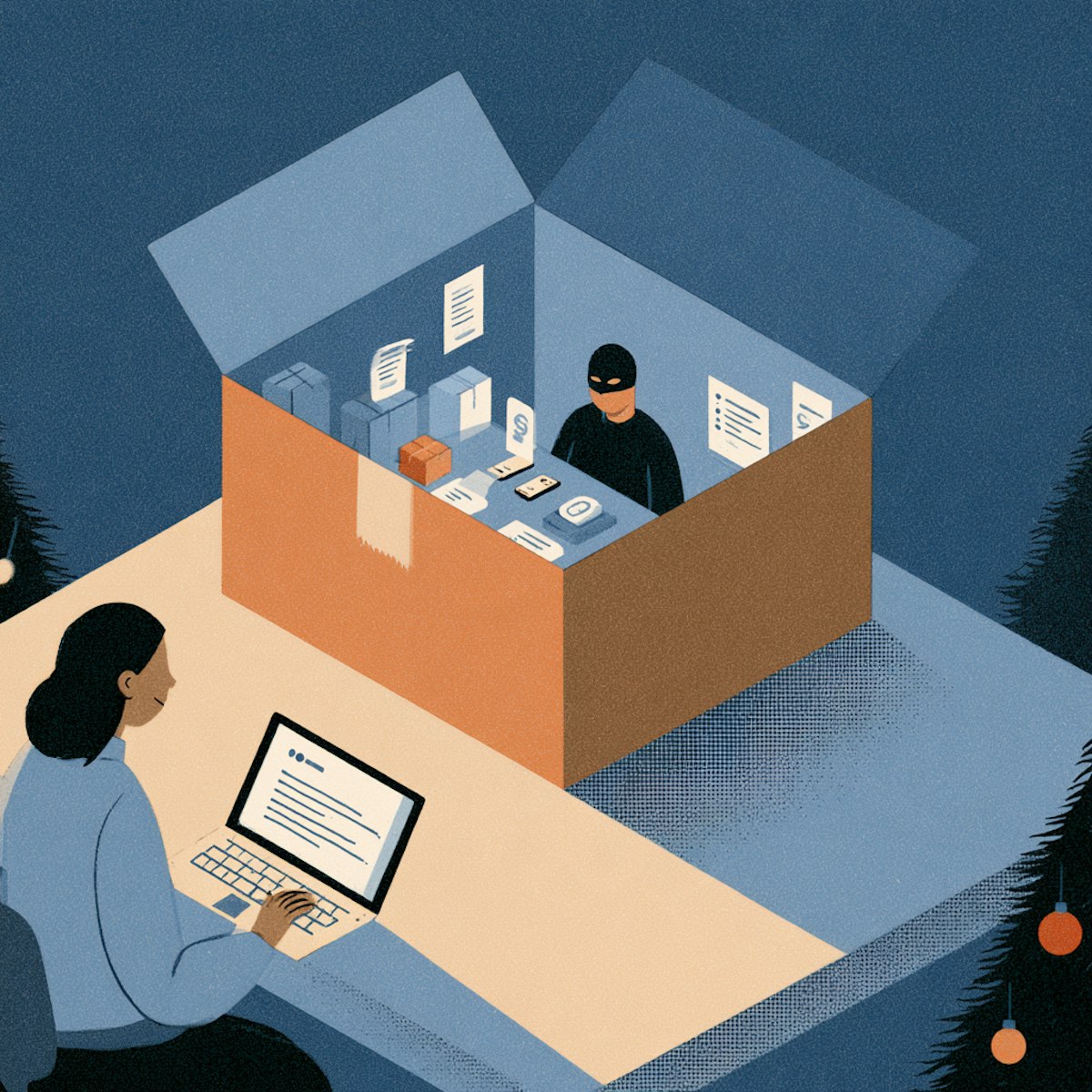
An email lands in your inbox from what looks like a logistics company, offering a work-from-home role as a “package inspector.” The pay is good, the hours are flexible, and the job sounds easy. You’d receive packages at your house, check that everything’s in good shape, and ship them on to the next address using the labels they send you. If you’ve been looking for extra income before the holidays, it can feel like exactly what you needed.
Unfortunately, it’s a reshipping scam. The “employer” is using stolen credit card or bank information to buy expensive goods, and they need a regular home address to receive them so the shipments don’t raise suspicion. The FTC puts it plainly, saying reshipping goods is never a real job¹.
If you’ve been offered a job like this, or you’ve already shipped a few boxes, the sections ahead cover how these scams work, what the job posts tend to look like, and what to do next.
How do reshipping scams work?
Reshipping scams are built to feel like a normal hiring process, at least at first. Most of them follow the same basic pattern:
A recruiter reaches out to you. The offer might come through a job ad, an email, a text, or a message on social media. Many people never applied for anything, which is one of the first signs something’s off.
You’re hired almost right away. There’s usually little screening, no real interview, and no one asking about your experience. The “employer” may ask for your Social Security number, a photo of your ID, or bank details so they can “set you up for payroll.”
Packages start arriving at your home. They’re often expensive items like electronics, designer goods, or other things that are easy to resell.
You’re told to inspect, repackage, and send them on. The “employer” emails you prepaid shipping labels, and the packages often go to another address in the U.S. or overseas.
The paycheck never shows up. After a few weeks of work, the pay is delayed, never arrives, or comes as a check that bounces. By then, the “company” may have stopped answering.
What makes this scam so convincing is that the packages are real. According to the FTC, scammers buy the goods with stolen credit card or bank information, and some even claim to work with well-known companies¹. When boxes are showing up and you’re following clear instructions, it can feel like a legitimate job right up until it isn’t.
How exposed is your personal information?
Take our free risk quiz to see where your data may be exposed online.
Take the Risk Quiz
What fake seasonal job offers look like
Fake job offers rarely look suspicious at first. They borrow the same language you’d see in a real listing, with official-sounding titles like “logistics coordinator,” “shipping assistant,” or “quality control specialist.” The pitch is usually some version of easy money, with promises of good pay, flexible hours, no experience required, and the chance to work from home. The BBB has shared reports from people who were hired to receive and reship packages with very little screening, and who only started to suspect a package mule scam after noticing that the company’s hiring process and business details didn’t quite add up².
The timing works in the scammer’s favor, too. Plenty of real companies hire extra help for the holidays, so an offer for seasonal work in November doesn’t seem out of place. That’s exactly why it’s worth taking a closer look before you say yes. Some of these offers point you to a polished company website to make the job feel more legitimate, so it helps to know how to tell if a website is legit (pending) before you share any personal information.
The red flags in a job post and onboarding process
Most reshipping scams give themselves away somewhere between the first message and your first “assignment.” Here’s what to look out for:
The job involves packages coming to your home. The U.S. Postal Inspection Service advises against taking any job that has you send or receive packages for someone else. This one red flag alone is enough to walk away⁵.
You’re asked to repackage items or print shipping labels. Real companies have warehouses and shipping teams for this. They don’t route products through an employee’s living room.
They want your personal documents right away. Real employers do collect details like your Social Security number for payroll, but only after a formal offer and through a secure onboarding process. A “recruiter” asking for a photo of your driver’s license, your Social Security number, or bank details before you’ve had a real interview is a warning sign.
The pay is unusual or keeps getting delayed. You’re promised a check that never arrives, a check that bounces, or payment that’s always “coming next week.”
The recruiter only talks to you through a messaging app. Legitimate hiring usually happens through a company email address, a job portal, or an actual phone or video interview, not exclusively through a chat app or text.
You’re hired almost instantly. No interview, no questions about your experience, and an offer within hours of your first conversation is a sign they don’t care who you are, only where you live.
You can’t find any proof the company exists. There’s no physical address, no independent reviews, no news coverage, and the website looks like it went up recently.
What does “money mule” mean?
A money mule is someone who moves money or goods for criminals. USPIS describes money mules as people who receive and transfer money stolen from fraud victims, and it lists work-from-home offers to reship packages as one of the ways people are recruited.3 A package mule is the same idea with goods instead of cash.
What are the risks if you already shipped packages or shared your ID?
The risks often fall into two areas, and it helps to understand both.
Your personal exposure
The U.S. Postal Inspection Service warns that moving money or valuables for other people helps criminals and may lead to serious consequences for you. What that means for any one person depends on their specific situation, and this article isn’t legal advice. If you’re concerned about where you stand, it’s a good idea to talk with a lawyer, especially before you respond to the “employer” again.
Your identity
If you sent the “employer” your Social Security number, a copy of your ID, or your bank details, that information is now in the hands of someone who was never really hiring you. It can be used to open new accounts in your name, take over accounts you already have, or pass yourself off as you in a future scam.
Stay safe with identity theft protection
OmniWatch provides dark web and Social Security number monitoring, identity theft protection with up to $4 million in identity theft insurance,* and restoration support to help resolve identity theft.
Identity Theft ProtectionWhat you should do next
If you've been recruited, or you've already shipped packages:
Stop forwarding packages. Don't accept more, and don't send anything else.
Keep your records. Save the job posting, messages, labels, tracking numbers, and payment details.
Report it. Tell the FTC and the U.S. Postal Inspection Service. You can also use BBB Scam Tracker.4
If you received a package from someone you don't know, USPIS advises refusing it or returning it to the sender.5
Protect your identity. If you shared ID or financial details, follow our guide on how to report identity theft (pending), and watch your accounts.
Tell a friend or family member. USPIS suggests checking any work-from-home offer with a trusted person.
How to check a job offer before you accept
A little research can tell you a lot about a job offer before you hand over any personal information. Here’s how to check that an offer is real:
Find the company on your own. Type its official website into your browser yourself and look for the same job on its careers page.
Confirm the recruiter works there. Reach out through the contact info on the company’s official site and ask if that person is on their hiring team.
Look up what others are saying. Search the company’s name with “scam,” “reviews,” or “complaints.”
Know the deal-breakers. A real job won’t ask you to pay to start or to receive and forward packages or money for someone else.
Be wary of fast offers. Real hiring usually takes more than a few chat messages.
Get a second opinion. The USPIS⁵ recommends running any work-from-home offer by someone you trust.
Check a job offer with OmniWatch
When you’re hoping for extra income, it’s easy to want an offer to be real. If a recruiter reaches out by text, email, or direct message and something about it feels a little too easy, OmniWatch members with included scam protection can run the message through the AI Scam Checker before replying. It’ll label the offer as likely safe, unverified, likely spam, or a scam, giving you one more thing to weigh before you share any personal details.
Frequently Asked Questions
What is a reshipping scam?
A reshipping scam is a fake job where you receive packages at home and forward them elsewhere. The FTC says scammers use stolen credit card or bank information to buy the goods. The FTC also says reshipping goods is never a real job, so treat any such offer as a scam.
Is reshipping packages from home ever a real job?
No. The FTC says reshipping goods is never a real job, and USPIS advises against taking any job that involves sending or receiving packages for others. Real employers don't use workers' homes to receive and forward goods, so treat the offer as a scam, however professional it looks.
What does package mule mean?
A package mule is someone who receives and forwards goods for criminals, often without knowing. USPIS describes money mules as people who receive and transfer money stolen from fraud victims, and lists reshipping jobs as a recruiting method. Many mules believe they have a legitimate remote job.
What should I do if I already shipped packages?
Stop forwarding, keep your records, and report it to the FTC at ReportFraud.ftc.gov and to USPIS at uspis.gov/report. Protect your identity if you shared documents, and consider talking with a lawyer if you're worried. USPIS warns that acting as a mule may have serious consequences.
Are Temu job offers legit?
Don't assume an offer is real because it uses a well-known name. Scammers often borrow trusted names. Find the company's official careers page yourself, and treat any offer to receive and reship packages as a scam. We aren't saying whether any specific offer is real; check the employer directly.

This guide is published by OmniWatch, an identity and scam protection company. Follow OmniWatch on LinkedIn for ongoing guidance on identity protection and digital safety.
Sources
1. Federal Trade Commission Consumer Alert, reshipping scams, December 2025. https://consumer.ftc.gov/consumer-alerts/2025/12/can-you-unbox-signs-reshipping-scam
2. Better Business Bureau, news release on work-from-home reshipping reports. https://www.bbb.org/article/news-releases/38697
3. U.S. Postal Inspection Service, money mule guidance. https://www.uspis.gov/money-mule
4. Better Business Bureau, BBB Scam Tracker. https://www.bbb.org/scamtracker
5. U.S. Postal Inspection Service, "Be Smart: Reshipping Scams" handout. https://www.uspis.gov/wp-content/uploads/2021/08/uspis-be-smart-reshipping-scams-handout_508.pdf