
 Call us at (877) 892-8249

Identity theft is one of the most widespread financial crimes affecting Americans today.
$15.9B
According to the Federal Trade Commission, there were more than 3 million reports of fraud, with total fraud losses across all categories surpassing $15.9 billion. 1
Behind each of those reports is a real person dealing with frozen accounts, disputed charges, damaged credit, and, in many cases, months of paperwork to restore their financial footing.
While no single measure eliminates all exposure, a layered approach to protecting your personal information can significantly reduce the probability that your identity will be compromised. This guide covers the most impactful steps you can take, why each one matters, and what to do if something slips through.
What makes identity theft so common
Identity theft remains a persistent threat because the tools fueling it (data breaches, dark web markets, phishing campaigns, and social engineering schemes) have made personal data more accessible than ever.
When a major organization is compromised, millions of records, including Social Security numbers, addresses, login credentials, and financial account data, can be exposed in a single event. Consumers who did nothing wrong become vulnerable simply because they were customers or patients of the breached entity. In 2024 alone, TransUnion documented more than 3,000 data breaches in the U.S., and the damage didn’t stop there. The severity of those breaches, and their potential to fuel downstream fraud, hit its highest point since 2020.2
The problem compounds when stolen data is recycled. Information acquired in one breach is often used to commit fraud months or even years later, meaning victims may have no idea their data was exposed until a creditor contacts them about an account they never opened. This delayed discovery window is one reason why active, ongoing monitoring is more protective than a one-time response.
The most important steps to prevent identity theft
1. Freeze your credit
A credit freeze, also called a security freeze, is one of the most powerful tools available to consumers. It restricts access to your credit report, which means lenders cannot open new accounts in your name without your explicit authorization. Freezes are free and can be placed and lifted at any time through the three major credit bureaus: Equifax, Experian, and TransUnion.
A freeze does not affect your credit score, does not prevent you from using existing accounts, and does not block employers or insurers from accessing your report. The Consumer Financial Protection Bureau recommends freezes as a proactive measure, not just a reactive one.3 Unless you are actively applying for new credit, don’t leave your credit file accessible to lenders.
2. Monitor your credit reports regularly
Free credit reports from all three bureaus are available through AnnualCreditReport.com. Reviewing them regularly allows you to catch unauthorized accounts, inquiries, or address changes that may indicate fraud. Checking once a year is the minimum; spacing out requests across the year (one bureau every four months) provides more consistent coverage.
Look for accounts you do not recognize, hard inquiries you did not initiate, employers listed on your report that are not yours, and addresses you have never lived at. Any of these can signal that someone has used your information to apply for credit. The sooner you identify the discrepancy, the faster you can dispute it and limit damage.
Manual reviews are a good habit—but gaps between checks can leave room for fraud to grow undetected. For real-time coverage, OmniWatch’s credit monitoring alerts you the moment a change hits your report, so you always know what’s happening with your credit.
OmniWatch’s credit monitoring3. Enable multi-factor authentication on every important account
Multi-factor authentication (MFA) requires a second form of verification, typically a code sent to your phone or generated by an authentication app, in addition to your password. Even if a thief obtains your login credentials through a phishing attack or data breach, they cannot access your account without also having access to your second factor.
Enable MFA on your bank accounts, email, tax software, investment accounts, and any other platform that holds financial or personal data. Authenticator apps (such as Google Authenticator or Authy) are more secure than SMS-based codes, since phone numbers can be hijacked through SIM-swapping attacks. The extra step takes seconds and adds a meaningful layer of protection.
4. Use strong, unique passwords and a password manager
Reusing passwords across accounts is one of the most common (and most avoidable) security mistakes. When a single breach exposes your credentials, criminals test those same username-password combinations across dozens of other services, a technique called credential stuffing. A unique password for each account ensures that one breach does not cascade into multiple compromised accounts.
Rather than trying to remember dozens of different logins, password managers generate, store, and autofill complex passwords for you. They also alert you when a stored password has appeared in a known breach. Using a password manager is one of the lowest-friction, highest-impact steps the average person can take to protect their accounts.
5. Be vigilant about phishing and social engineering
Phishing, the use of deceptive emails, texts, or websites to steal credentials or personal information, remains the most frequently reported contact method for fraud, according to the FTC.1 These attacks have grown more sophisticated over time, often using legitimate-looking domain names, copied branding, and personalized details sourced from previous breaches to appear credible.
The clearest warning signs include: unexpected requests to verify your identity, messages creating urgency around account suspension or refunds, links that differ slightly from a company's real URL, and requests for personal information through a medium the company would not normally use. When in doubt, go directly to the company's website by typing the URL in your browser, rather than clicking any embedded link.
Social engineering extends beyond email. Phone-based scams, also known as vishing, involve callers posing as bank representatives, government officials, or tech support agents. They may already know partial information about you, sourced from previous breaches or public records, to build credibility before requesting more.
6. Protect your Social Security number
Your Social Security number (SSN) is the key piece of identifying information used to open financial accounts, file taxes, and access government benefits. Once it is in the wrong hands, the damage can take years to fully unwind.
Do not carry your Social Security card in your wallet. Provide your SSN only when it is legally required, such as for tax filings, employment paperwork, or financial account applications, and ask why it is needed before supplying it. Be particularly cautious about providing your SSN over email, through online forms on websites you are not certain are legitimate, or in response to unsolicited requests.
Tax-related identity theft, in which someone files a fraudulent return in your name before you do, is one of the most disruptive forms of the crime. The IRS offers an Identity Protection PIN (IP PIN) program that assigns a six-digit code required to file any return under your SSN. It is free and one of the most underutilized defenses against refund fraud. For more on protecting yourself specifically during tax season, OmniWatch's guide to tax season identity theft prevention covers the specific steps to take before, during, and after filing.
7. Set up dark web monitoring
Dark web markets are where stolen personal data is bought and sold after breaches. Email addresses, Social Security numbers, financial account credentials, and passport numbers all have market value on these platforms, and the lag time between a breach and the appearance of your data on the dark web can be months or years.
Dark web monitoring tools scan these markets and alert you when your personal information, your email addresses, phone number, SSN, or financial accounts appear in known breach databases or is actively being traded. An alert does not necessarily mean fraud has occurred, but it does mean your information is in circulation and that you should take protective steps: change any affected passwords, consider a credit freeze, and monitor your accounts more closely.
8. Be careful about what you share publicly
Identity thieves build profiles by aggregating publicly available information. Social media posts, directory listings, public records, and even casual online activity can supply answers to common security questions (mother's maiden name, name of your first pet, high school mascot) or provide enough context to convincingly impersonate you in phone-based scams.
Review your social media privacy settings and limit the visibility of your profiles to people you know. Avoid posting your full birthdate, home address, or workplace publicly. Consider whether the information you include in public bios or directory listings could be used to answer security questions or build a fraudulent identity.
9. Shred sensitive physical documents
Mail theft and dumpster diving remain viable methods for obtaining the personal information needed to commit identity theft. Tax documents, bank and brokerage statements, pre-approved credit card offers, medical bills, and utility bills all contain information that can be used to open accounts or answer verification questions.
10. Secure your physical mail
If you are expecting sensitive documents, a new credit card, a tax refund check, a Social Security card, or an insurance explanation of benefits, and they do not arrive, report it to the relevant institution immediately. Mail theft is more common than most people assume, and a missing piece of mail can signal either that theft has already occurred or that your mail is being diverted.
Consider using a P.O. box for sensitive correspondence if you do not have a secure residential mailbox. You can also sign up for USPS Informed Delivery, a free service that emails you daily images of the mail addressed to your house before it arrives. This makes it easy to notice when expected mail does not show up.
11. Monitor your financial accounts frequently
Waiting for a monthly statement to review your account activity gives fraudsters weeks to use your accounts before you notice. Log in to your bank, credit card, and investment accounts at least once a week. Most financial institutions now offer real-time transaction alerts via text or email. Enable these so you are notified of any charge or withdrawal the moment it posts.
If you see a transaction you do not recognize, report it immediately. Under federal law, your liability for unauthorized transactions is limited if you report them promptly, but the window matters. For debit cards, reporting within two business days limits liability to $50; waiting beyond 60 days can expose you to the full amount of any unauthorized transfers.
12. Be mindful of public Wi-Fi
Unsecured public Wi-Fi networks at coffee shops, airports, and hotels can expose your internet traffic to anyone on the same network with the right tools. Avoid logging in to banking, investment, email, or any accounts containing sensitive information while connected to a public network.
If you need to use public Wi-Fi for more than casual browsing, consider using a virtual private network (VPN). A VPN encrypts your internet traffic, making it much harder for anyone on the same network to intercept your data. Some identity protection services bundle VPN access with their monitoring features, which can simplify the setup.
13. Place a fraud alert if you suspect exposure
A fraud alert notifies lenders to take additional verification steps before opening new accounts in your name. It is less restrictive than a credit freeze; lenders can still access your report, but it prompts them to verify your identity before proceeding. An initial fraud alert lasts one year and is free to place at any of the three major credit bureaus (which are then required to notify the others).
If you have been a confirmed victim of identity theft, you can place an extended fraud alert that lasts seven years and entitles you to two free credit reports per year from each bureau, beyond the standard annual reports. Extended alerts are available to those who have filed a report with the FTC or law enforcement.
14. Watch for warning signs of identity theft
Recognizing identity theft early substantially limits the damage. The most common warning signs include:
Unfamiliar accounts or inquiries appearing on your credit report
Bills or collection notices for debts you do not recognize
Mail or expected financial statements that stop arriving
Being denied credit for no apparent reason despite a clean history
Medical explanation-of-benefits statements listing care you never received
IRS notices about duplicate tax returns or income from employers you do not recognize
Bank or creditor alerts about transactions you did not authorize
Calls from debt collectors about accounts you never opened
Any single one of these can indicate fraudulent activity. Investigate immediately rather than assuming it is an error; in many cases, it is not.
15. Understand synthetic identity theft
Synthetic identity theft is a form of fraud in which criminals combine a legitimate Social Security number, often belonging to a child, an elderly person, or someone with minimal credit history, with fabricated personal details to create a fictional identity. Unlike traditional identity theft, there may be no immediate victim to notice the fraud. TransUnion's research found that U.S. lenders faced more than $3.3 billion in exposure from synthetic identity fraud for the year ending 2024, and that synthetic identity fraud was the fastest-growing type of digital fraud globally in the first half of 2024.4
Because synthetic identities are constructed over months or years, with fraudsters often building credit histories before ultimately defaulting on high-value accounts, they are difficult to detect until significant damage has occurred. Parents of minor children should consider placing a credit freeze on their child's Social Security number as a precaution, since children's SSNs are attractive targets precisely because they are unlikely to be monitored.
What to do if your identity is stolen
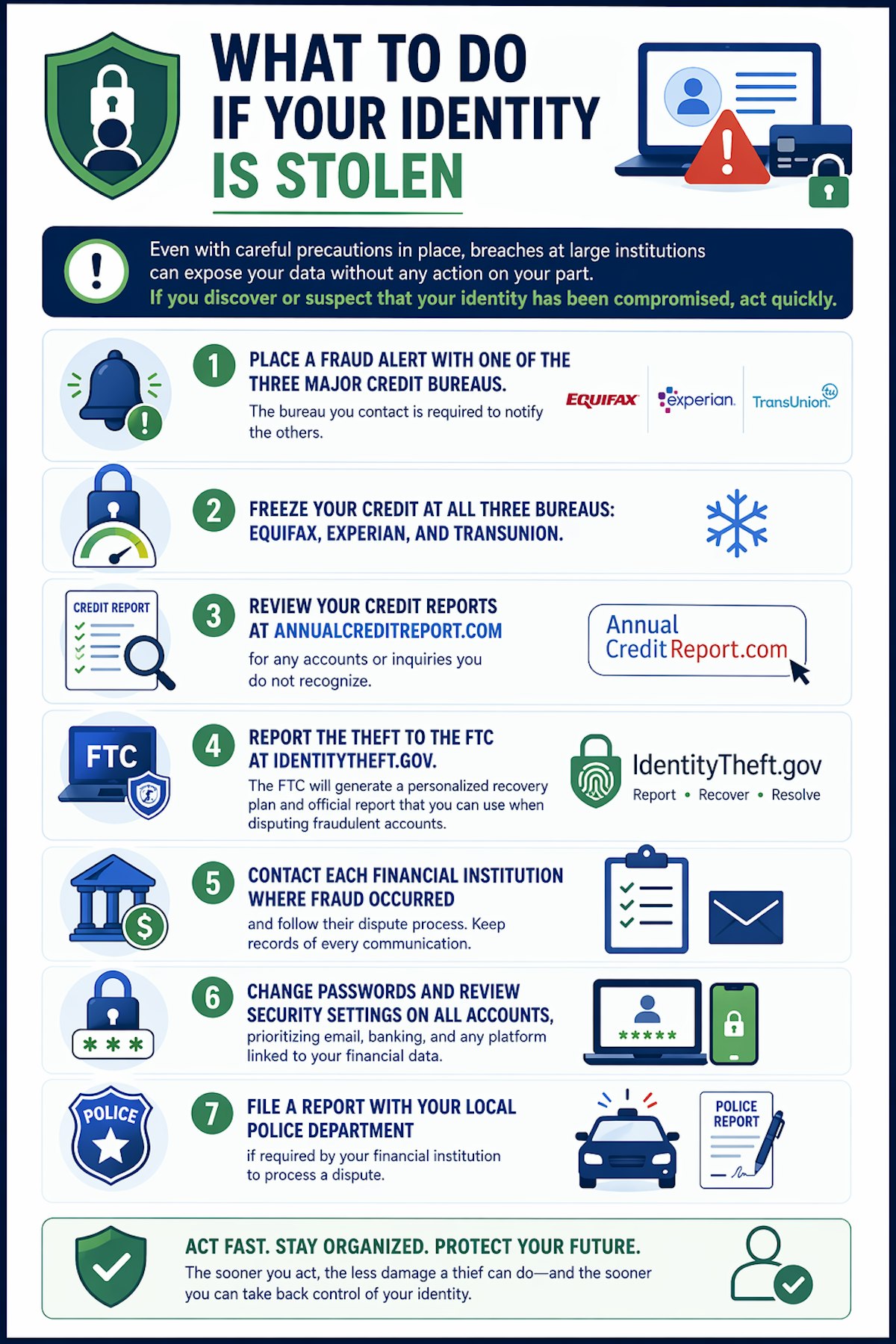
Even with careful precautions in place, breaches at large institutions can expose your data without any action on your part. If you discover or suspect that your identity has been compromised, act quickly.
Place a fraud alert with one of the three major credit bureaus. The bureau you contact is required to notify the others.
Freeze your credit at all three bureaus: Equifax, Experian, and TransUnion.
Review your credit reports at AnnualCreditReport.com for any accounts or inquiries you do not recognize.
Report the theft to the FTC at IdentityTheft.gov. The FTC will generate a personalized recovery plan and official report that you can use when disputing fraudulent accounts.
Contact each financial institution where fraud occurred and follow their dispute process. Keep records of every communication.
Change passwords and review security settings on all accounts, prioritizing email, banking, and any platform linked to your financial data.
File a report with your local police department if required by your financial institution to process a dispute.
If you have identity theft insurance or access to a restoration service through a protection plan, contact your provider as well. Services like those offered by OmniWatch include identity restoration support as part of their coverage, which can help coordinate the process of working across multiple institutions simultaneously.
The role of identity theft protection services
Identity theft protection services provide monitoring, alerts, and in some cases, insurance coverage and restoration support that go beyond what individuals can reasonably do on their own. The most valuable features to look for in any service include:
Real-time credit monitoring: Alerts when new accounts, hard inquiries, or other changes appear on your credit report
Dark web monitoring: Scanning for your personal data in breach databases and dark web markets
Social Security number monitoring: Alerts if your SSN is used in ways that suggest fraud
Financial account monitoring: Tracking for unusual transactions or access attempts
Identity theft insurance: Coverage for expenses associated with restoring your identity, including legal fees, lost wages, and out-of-pocket costs
Restoration support: Access to specialists who help you navigate the process of disputing fraud across multiple institutions
The gap between when fraud begins and when most people first notice it is frequently measured in weeks or months. Monitoring tools close that gap by providing real-time or near-real-time alerts so you can act before more damage accumulates.
A protection service does not replace the preventive steps described in this guide—no technology eliminates all exposure. But it does provide a safety net for the moments when prevention is not enough. For a more detailed look at the financial and personal impact of identity theft, OmniWatch's 2025 identity theft statistics offer a comprehensive breakdown of current trends, high-risk demographics, and where protection gaps remain most significant.
Frequently asked questions
What is the single most effective way to prevent identity theft?
How do I know if my identity has already been stolen?
Can I prevent identity theft from data breaches I have no control over?
Is identity theft protection worth it?
What should parents do to protect their children from identity theft?
This guide is published by OmniWatch. Follow OmniWatch on Facebook for ongoing guidance on identity protection, digital safety, and scam awareness.
1 Federal Trade Commission, Consumer Sentinel Network Data Visualizations 2026
2 TransUnion, Money 20/20: What’s Behind the Rise in Synthetic Identity Fraud 2025
3 Consumer Financial Protection Bureau, What Do I Do If I Think I Have Been a Victim of Identity Theft? 2025
4 TransUnion, Are Your Customers Real? Synthetic Identities Are Driving Fraud 2025