
 Call us at (877) 892-8249


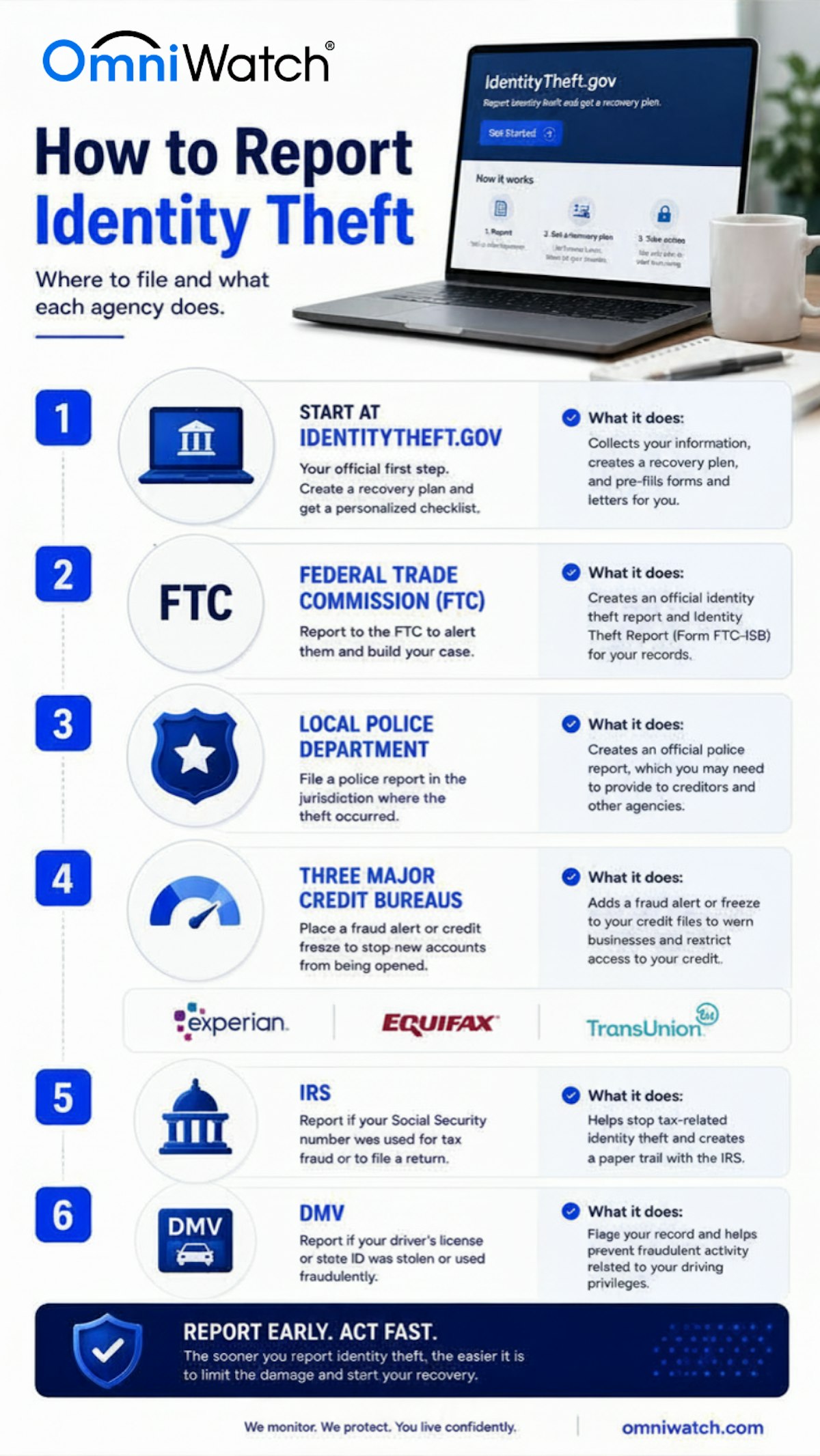
The first hours after identity theft matter more than people realize. This guide gives you the exact steps to take (in the order experts recommend), explains the rights you gain when you file an official report, and outlines what to expect during identity theft recovery. Remember: You don’t have to do it alone. OmniWatch is here to help streamline the process below:
First, confirm the theft and stay calm
Identity theft often surfaces quietly. It may begin with a small charge you do not recognize, a bill for an account you never opened, a denial of credit, or a tax return rejected as a duplicate. Any one of these can signal that someone is using your personal information. For a fuller list of early indicators, OmniWatchⓇ maintains a separate guide on the signs of identity theft.
The scale of the problem is significant. The FBI's Internet Crime Complaint Center logged 1,008,597 complaints in 2025, with reported losses of $20.9 billion, a 26% increase over the prior year and an average reported loss of $20,699 per incident.1 Once you have reason to believe your identity has been compromised, the priority shifts from worrying to working through a sequence of concrete steps.
How exposed is your personal information?
Take our free risk quiz to see where your data may be exposed online.
Take the Risk Quiz
Step 1: Contact the companies where fraud occurred
Start with the businesses where you know or suspect fraud has happened. Call the fraud department of each bank, card issuer, or lender and explain that someone has stolen your identity. Ask them to close or freeze the affected accounts so no new charges can be added without your approval.
While you are on the phone, change the logins, passwords, and PINs on those accounts. If a thief reached one account, treat any account that shares a password as exposed.
Federal law works in your favor here. For unauthorized credit card charges, your liability is capped at $50, and if you report a lost or stolen card before it is used, you are not responsible for unauthorized charges at all.2 You may need to contact these companies again once you have an official identity theft report, which the next steps cover.
Step 2: Place a fraud alert and freeze your credit
Next, limit a thief's ability to open new accounts in your name. You have two related tools, and they serve different purposes.
A fraud alert is free and requires businesses to verify your identity before issuing new credit. You only need to contact one of the three credit bureaus, because that bureau must notify the other two. An initial fraud alert lasts one year and can be renewed.2
A credit freeze is stronger. It restricts access to your credit report so new accounts cannot be opened until you lift it. A freeze is free, and you must place it with each bureau separately: Experian, Equifax, and TransUnion. The difference between credit monitoring and a credit freeze is simple: monitoring alerts you to changes after they happen, while a freeze blocks new accounts before they can be opened.
While you are at it, pull your free credit reports from all three bureaus at AnnualCreditReport.com and note any account or transaction you do not recognize. These entries become the basis for the disputes you file later.
Step 3: Report the theft to the FTC at IdentityTheft.gov
Filing an official report is the step that unlocks your strongest legal protections. Report the theft to the Federal Trade Commission at IdentityTheft.gov, or call 1-877-438-4338. The site asks about the type of fraud and the accounts involved, then generates two things: an FTC Identity Theft Report and a personalized recovery plan.3
The report carries real weight. It serves as an official statement that your identity was stolen, and creditors, debt collectors, and credit bureaus all recognize it. With it, you gain the right to have fraudulent accounts blocked from your credit file, typically within four business days of your request.3 The recovery plan is interactive and tailored to your situation, with pre-filled dispute letters you can send directly to the businesses and bureaus involved.
If you create an account on the site, it tracks your progress and updates your plan as your case develops. Save or print your report either way, because it is the document you will reference throughout recovery.
Step 4: Consider a police report
A police report is not always required, but it helps in specific situations. File one if you know the identity of the thief, if a creditor or bank asks for it, or if the theft involves a significant or complex loss.
Bring your FTC Identity Theft Report, a government-issued ID, proof of address, and any evidence of the fraud, such as collection notices or statements showing charges you did not make. Ask for a copy of the police report or the report number, and keep it with your records.
Step 5: Dispute fraudulent accounts and charges
With your FTC report in hand, return to each business where a fraudulent account was opened, or a fraudulent charge was made. Tell them you are an identity theft victim, send a copy of your report, and request that they close the account and remove the fraudulent activity.
Ask each credit bureau to block the fraudulent information from your report. When you have an FTC Identity Theft Report, the bureaus must honor a valid request to block information that resulted from the theft. Without the report, you can still dispute incorrect entries, though the process can take longer and offer fewer guarantees.3
Step 6: Address specialized forms of identity theft
Some categories of identity theft require their own steps. Tax identity theft, in which someone files a return using your Social Security number, calls for IRS Form 14039, the Identity Theft Affidavit, which IdentityTheft.gov can help you complete.3 Medical identity theft requires contacting your health insurer's fraud department and reviewing your medical records for errors.
If your Social Security number is involved, review OmniWatch's guide to protecting your Social Security number for the specific actions that apply. Understanding how identity theft happens in the first place also helps you close the gaps that a thief used to reach you.
Each specialized case has a defined process, so match your response to the type of fraud rather than treating every incident the same way.
How long does identity theft recovery take?
Recovery time varies with the type and depth of the fraud. A single fraudulent credit card charge may be resolved in days. A case involving multiple new accounts, tax fraud, or mixed records can take many months, and complex government-related cases sometimes stretch beyond a year.
Two factors shorten the timeline more than any others: how quickly you act after discovering the theft, and how complete your documentation is. Victims who freeze credit early, file an FTC report promptly, and keep organized records consistently resolve their cases faster than those who delay.
Persistence matters during the long tail of recovery. Fraudulent entries can reappear, and a well-kept file lets you dispute them again quickly with the same evidence.
Let OmniWatch handle the hard parts of recovery
Recovery is faster when you have someone handling the legwork for you. Our 24/7 identity restoration agents can place fraud alerts and credit freezes, contact creditors on your behalf, and prepare dispute documentation (so you’re not spending hours on hold or figuring out who to call next).
If you suspect your identity is actively being misused, members can reach OmniWatch any time at (877) 892-8249, 24 hours a day. OmniWatch plans also protect you during recovery with up to $4 million in identity theft insurance or up to $8 million for families.
Plus, OmniWatch now covers crime categories that represented 94% of the cybercrime complaints filed with the FBI in 2025, including scam and ransomware losses that many traditional policies exclude.4 Whether you’re working through this now or preparing for the future, you don’t have to figure it out alone.
Stay safe with identity theft protection
OmniWatch provides dark web and Social Security number monitoring, identity theft protection with up to $4 million in identity theft insurance,* and restoration support to help resolve identity theft.
Identity Theft ProtectionA quick-reference identity theft recovery checklist
Use this condensed sequence as a starting point, then follow the detailed steps above for each item.
Call the companies where fraud occurred and close or freeze those accounts.
Place a free fraud alert with one credit bureau and freeze your credit with all three.
Report the theft at IdentityTheft.gov to get your FTC report and recovery plan.
File a police report if a creditor requires one or if you know the thief.
Dispute fraudulent accounts and ask the bureaus to block fraudulent entries.
Handle any tax, medical, or Social Security-specific steps that apply.
Change passwords, enable two-factor authentication, and keep detailed records.
Frequently asked questions
What is the very first thing to do if my identity is stolen?
Contact the companies where the fraud occurred and ask them to freeze or close the affected accounts, then place a fraud alert and freeze your credit. These steps stop further damage while you complete an official report.
Do I have to file a police report for identity theft?
Not always. An FTC Identity Theft Report from IdentityTheft.gov is sufficient for most businesses and credit bureaus. File a police report if a specific creditor requires it or if you know who the thief is.
How much will identity theft cost me out of pocket?
Federal law caps your liability for unauthorized credit card charges at $50, and many victims pay nothing if they report promptly. Other costs, such as legal fees and lost wages, may be offset by identity theft insurance if you carry it.
Can I recover from identity theft myself?
Yes. The federal tools at IdentityTheft.gov are free and guide you through each step. Some people choose a protection service for monitoring, restoration help, and insurance, but it is not required to recover.
How long does it take to fix identity theft?
Simple cases can resolve in days, while complex cases involving tax fraud or multiple accounts can take a year or more. Acting quickly and keeping thorough records are the biggest factors in a faster recovery.

This guide is published by OmniWatch. Follow OmniWatch on Facebook for ongoing guidance on identity protection, digital safety, and scam awareness.
Sources
Federal Bureau of Investigation, Internet Crime Complaint Center (IC3) 2025 Internet Crime Report, April 2026.
Federal Trade Commission, Identity Theft Recovery Steps, 2026.
Federal Trade Commission, IdentityTheft.gov: Report Identity Theft and Get a Recovery Plan, 2026.
Associated Press, OmniWatch Now Covers 94% of FBI-Tracked Cybercrime, April 2026.