
 Call us at (877) 892-8249


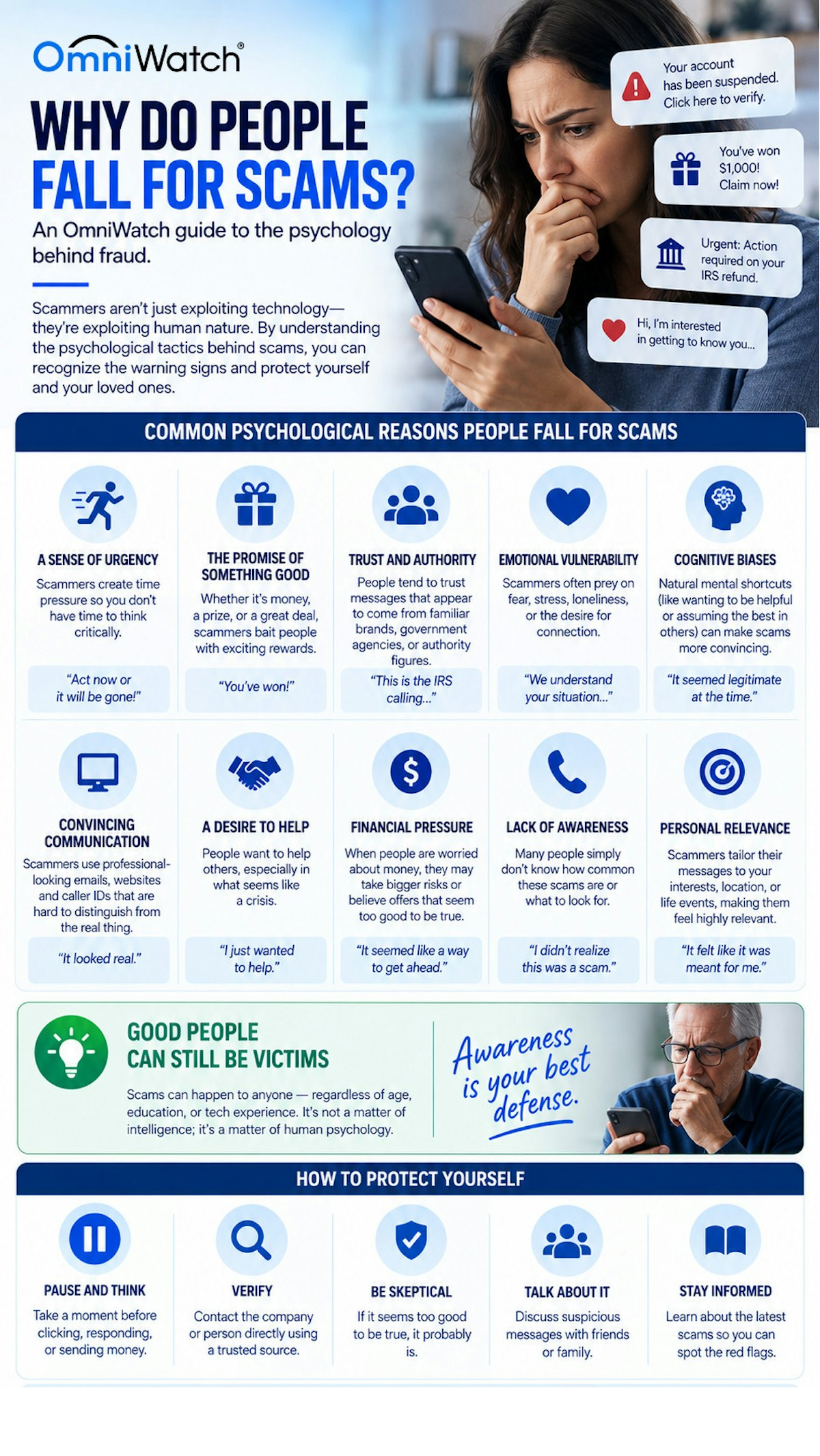
People fall for scams because scams are engineered to exploit normal human psychology, not because victims are careless, naive, or unintelligent.
Fraudsters manufacture strong emotions like fear, urgency, and excitement that override careful thinking, and they impersonate trusted authorities to trigger the automatic compliance most people extend to a bank, an employer, or a government agency. Peer-reviewed research shows that susceptibility crosses every age, income, and education level.¹ Anyone can be caught, and the moment of greatest vulnerability is often a moment of stress, distraction, or hope.
That last point deserves emphasis before anything else. A person who falls for a scam has been targeted by a professional operation designed to defeat ordinary human judgment. Understanding the specific mechanics behind that manipulation is useful, because the tactics stay consistent even as the stories change. This guide explains why these schemes work on people of all kinds, and what actually helps.
Key takeaways
- Falling for a scam is not a sign of low intelligence or carelessness. Scams are built to bypass rational thought.
- A 2025 systematic review found that vulnerability to fraud affects all age groups.¹
- Scammers manufacture intense emotion, which suppresses the slower, analytical part of decision-making.
- Trust in authority, time pressure, and everyday politeness are all exploited as points of entry.
- Situational factors like stress, isolation, or a major life event can raise anyone's susceptibility for a time.
- AI-generated messages have removed old warning signs like spelling errors, making detection harder for everyone.
Scams exploit universal mental shortcuts
Human brains rely on mental shortcuts to move through a world full of decisions. These shortcuts are efficient and usually helpful, but they are also predictable, and predictability is exactly what a fraudster needs. Scammers study these cognitive patterns and build schemes around them.
Optimism bias, the tendency to assume bad outcomes happen to other people, is one of the most exploited. It produces the very "it could never happen to me" confidence that lowers a person's guard. Confirmation bias, the pull toward information that fits what someone already hopes is true, is another. A message promising a refund lands harder on someone expecting one, and an investment pitch feels credible to someone who wants to believe the returns are real. None of these shortcuts reflects a flaw in the individual. They are standard features of human cognition that a skilled manipulator turns into leverage.
How exposed is your personal information?
Take our free risk quiz to see where your data may be exposed online.
Take the Risk Quiz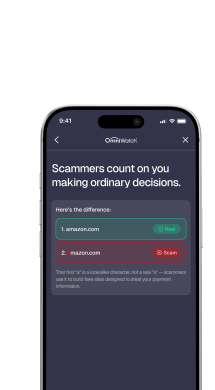
Emotion overrides logic
The single most powerful tool a scammer uses is emotion. When a message triggers fear, panic, urgency, or excitement, the body's stress response activates and rational, deliberate thinking takes a back seat. Research on fraud vulnerability has found that heightened emotional arousal measurably increases the chance of being deceived.¹
This is why so many scams open with a jolt. A frozen bank account, an arrest warrant, a package that cannot be delivered, or a prize that must be claimed within the hour all serve the same purpose: to push the target into a reactive state where verification feels like a luxury there is no time for.
A separate 2025 study from Macquarie University adds a subtle layer, suggesting that some victims are not fully convinced the story is true but choose to act on a hopeful version of it because the emotional payoff feels immediate.² In both cases, the mechanism is emotional, not logical, which is precisely why intelligence offers no protection.
Authority, urgency, and trust as entry points
Beyond raw emotion, scammers lean on a handful of social triggers that most people are conditioned to obey.
These are the same tactics detailed across the OmniWatch scams library, which catalogs how real schemes combine them. The uncomfortable truth is that the traits being exploited, trust and helpfulness, and respect for authority, are the traits of a functioning, decent person, not a gullible one.
Sophistication has removed the old warning signs
For years, people were taught to spot scams by their flaws: clumsy grammar, obvious spelling mistakes, and generic greetings. That advice has aged poorly. Fraudsters now use AI tools to produce messages that are fluent, personalized, and visually indistinguishable from legitimate communications.
The scale reflects this professionalism. The FBI's Internet Crime Complaint Center recorded more than one million complaints and a record $20.9 billion in losses in 2025, a 26 percent increase over the prior year.³ Voice cloning can now mimic a relative's voice from a short audio clip, and cloned websites replicate real login pages down to the pixel. When the surface signals that once betrayed a scam disappear, detection depends on process rather than instinct, and process is exactly what a manufactured sense of urgency is designed to short-circuit.
Anyone can be susceptible, and the stereotype is wrong
The popular image of a scam victim as elderly or inattentive is not supported by the evidence, and it does real harm by making younger and confident people feel immune. A 2025 systematic review of fraud vulnerability concluded plainly that people of all ages are vulnerable, with different scam types simply concentrating in different groups.¹
What tends to raise susceptibility is situational rather than personal. The same review identified factors like high impulsivity, social isolation, and reduced well-being as more predictive than age or education.¹ A person navigating grief, a job loss, financial pressure, loneliness, or simple exhaustion is more open to the right message at the wrong moment, and everyone passes through such periods.
This is why OmniWatch frames protection as something for entire households and communities, including resources like its guide to protecting older adults from scams, while stressing that no age group is exempt. Susceptibility is a human condition, not a personal failing.
How to protect yourself and the people around you
Because scams target universal psychology, the best defenses are structural habits that work even when emotion is running high. The goal is to build a pause into the moment a scammer is trying to rush.
Treat urgency as the warning sign itself, and slow down whenever a message demands immediate action.
Verify independently by contacting the company or person through a number or website you locate yourself.
Never pay with gift cards, wire transfers, or cryptocurrency at someone else's insistence.
Talk about scams openly with family and friends, since secrecy and shame are what let them succeed.
Report incidents at IdentityTheft.gov to start recovery and help authorities track schemes.⁴
Removing the stigma matters as much as any technical step. Victims who feel ashamed are less likely to report quickly or warn others, which gives scams room to spread. Technology can add a backstop here: AI-powered scam protection can flag fraudulent messages and links before a person interacts with them, and ongoing identity theft protection helps limit the damage when a scam succeeds. Neither replaces open conversation, which remains one of the strongest safeguards a family has.
Stay safe with identity theft protection
OmniWatch provides dark web and Social Security number monitoring, identity theft protection with up to $4 million in identity theft insurance,* and restoration support to help resolve identity theft.
Identity Theft ProtectionFrequently asked questions
Does falling for a scam mean I am gullible?
No. Scams are professionally designed to exploit normal human psychology, and research confirms that intelligence, education, and age do not make someone immune. Being deceived reflects the sophistication of the scheme, not a defect in the victim.
Why do smart, educated people still fall for scams?
Because scams work on emotion, not reasoning. When fear or urgency triggers the brain's stress response, rational analysis is suppressed, and that happens to everyone regardless of how intelligent they are.
Who is most likely to fall for a scam?
People of all ages are vulnerable. Situational factors like stress, isolation, financial pressure, or a recent life change tend to raise susceptibility more than age or education.
Why do scams create such a sense of urgency?
Urgency removes the time a person would otherwise use to verify the story. It is a deliberate tactic to force a decision before careful thinking can catch up.
Are scams getting harder to spot?
Yes. AI tools now let scammers write flawless, personalized messages and even clone voices, erasing the spelling errors and awkward phrasing that once served as warning signs.
What should I do if I or someone I know fell for a scam?
Act quickly and without shame. Contact the relevant bank or provider, change exposed passwords, and file a report at IdentityTheft.gov. Speed helps recovery far more than self-blame.

This guide is published by OmniWatch, an identity and scam protection company. Follow OmniWatch on LinkedIn for ongoing guidance on identity protection and digital safety.
Sources
Computers in Human Behavior, "Uncovering vulnerability to fraud and scams among adult victims in online and offline contexts: A systematic review," 2025. https://www.sciencedirect.com/science/article/abs/pii/S0747563225001815
Macquarie University, "Please explain: Why do people fall for implausible scams?" as published by Phys.org, October 2025. https://phys.org/news/2025-10-people-fall-implausible-scams.html
Federal Bureau of Investigation, Internet Crime Complaint Center (IC3), 2025 Internet Crime Report, April 2026. https://www.ic3.gov/AnnualReport/Reports/2025_IC3Report.pdf
IdentityTheft.gov, official identity theft reporting and recovery program. https://www.identitytheft.gov/
Security.org, "Identity Theft Statistics in 2026: Looking Into America's Fastest-Growing Crime," 2026. https://www.security.org/identity-theft/statistics/