
 Call us at (877) 892-8249

It is a fair question. Identity theft protection services cost real money, they require ongoing subscription payments, and their value is not always obvious until something goes wrong. For someone weighing $10 to $30 a month against a threat that feels abstract, the math is not immediately self-evident.
The data, however, is not abstract. According to Javelin Strategy and Research's 2026 Identity Fraud Study, combined identity fraud and scam losses in the United States totaled $38 billion in 2025, affecting 36 million Americans. The FBI's IC3 2025 Annual Report documented over one million cybercrime complaints for the first time, with total losses reaching $20.9 billion, a 26% increase over the prior year. The FTC's Consumer Sentinel Network recorded a record $15.9 billion in fraud losses in 2025, up from $12.5 billion in 2024.1
Whether identity theft protection is worth it depends on what it actually covers, how it compares to what you already have, and what the realistic cost of going without it looks like. We’ve looked at the data and the gaps that most plans don’t cover. Here’s what we found.
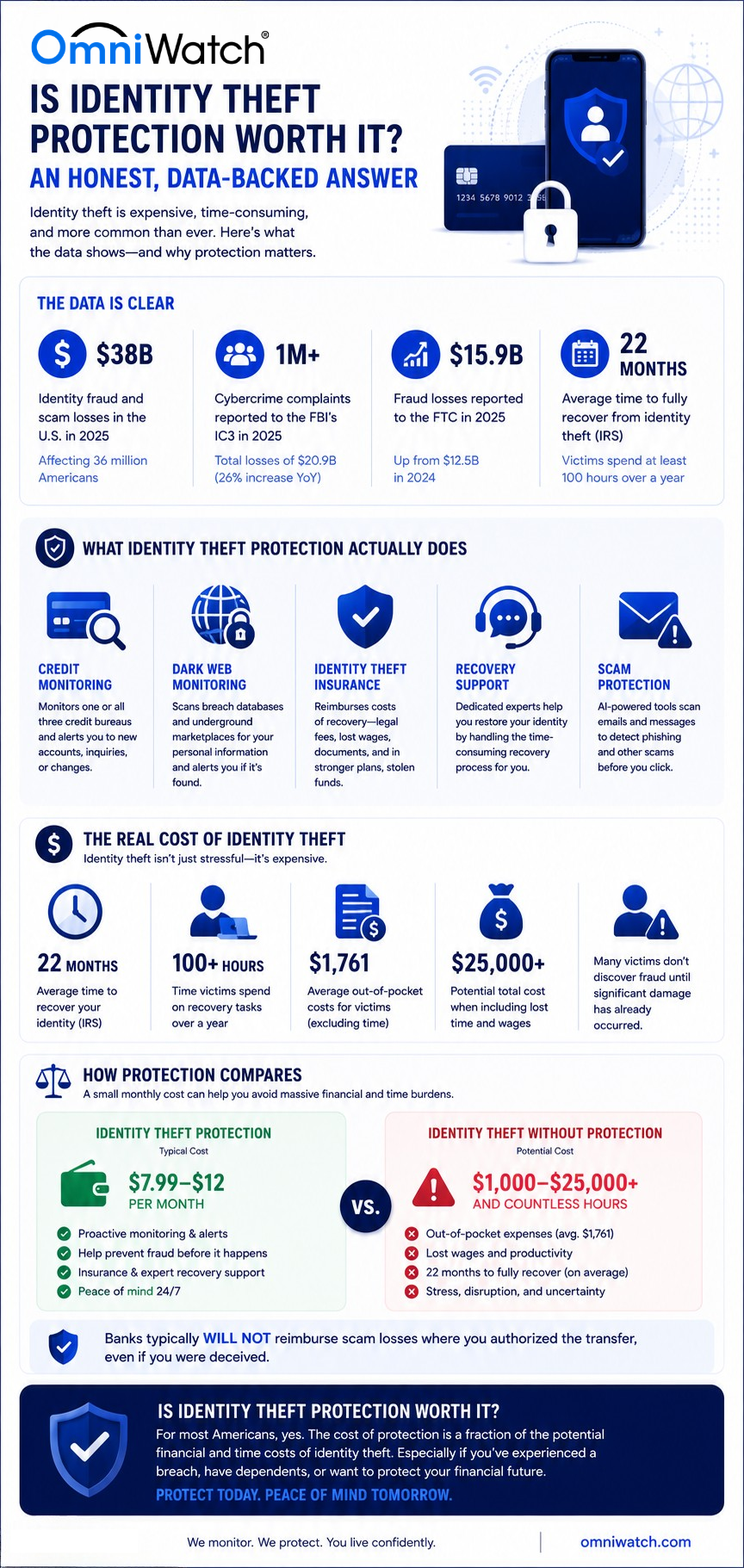
Is identity theft protection worth it?
For most Americans, yes. Identity theft protection is worth it when it covers monitoring and alerts across multiple data categories (credit, dark web, Social Security), includes meaningful identity theft insurance with human-led recovery support, and protects against modern scam types that banks and credit card companies will not reimburse. The case is strongest for people who have experienced a prior breach, have dependents on their plan, or carry significant financial assets they want to protect. The case weakens for people who are highly proactive about their own monitoring and already have credit freezes in place across all three bureaus. For everyone else, the cost of a plan is a small fraction of the potential cost of undetected fraud.
Key takeaways
- Identity fraud and scam losses totaled $38 billion in 2025, affecting 36 million Americans.
- The IRS reports that the average identity theft recovery takes 22 months to fully resolve.7
- Many victims spend at least 100 hours over a full year dealing with recovery tasks.8
- Protection plans start at $7.99, a fraction of average recovery costs.
- Banks typically will not reimburse scam losses where you authorized the transfer, even under deception.
- Identity theft protection is worth it for most people, especially those with prior breach exposure or financial dependents.
What identity theft protection actually does
Before deciding whether a plan is worth the cost, it helps to understand what it actually provides. Identity theft protection plans typically bundle several distinct features into a single subscription. The core components of a strong plan include:
Credit monitoring
Most plans monitor your credit file at one or all three major bureaus and alert you when a new account is opened, a hard inquiry is made, or your personal information changes. Three-bureau monitoring is meaningfully more comprehensive than single-bureau, since different creditors report to different bureaus and fraud can appear at any of them.
Dark web monitoring
Dark web monitoring tools scan breach databases and underground marketplaces for your personal identifiers, including email addresses, Social Security numbers, phone numbers, and financial account details.
+79%
The 2025 Identity Theft Resource Center Annual Report confirmed a record 3,322 data compromises in 2025, a 79% jump over the prior five years.2
When your data surfaces in one of these breaches, dark web monitoring delivers the alert before you discover the fraud firsthand.
Identity theft insurance
This is often the component that carries the most practical financial weight. Identity theft insurance reimburses the costs of recovery: legal fees, lost wages from time taken to resolve disputes, notary and document costs, and in stronger plans, stolen funds themselves. Coverage amounts vary significantly from plan to plan, and the fine print matters. Deductibles or scam reimbursement caps, common in plans that aren’t built for today’s fraud landscape, leave most victims substantially short.
Recovery support
Getting an alert is only half of it; knowing what to do next is where most people get stuck. Recovery support, whether through a dedicated case manager or a restoration specialist, handles the administrative work of resolving identity theft on your behalf: filing disputes with credit bureaus, contacting lenders, navigating FTC and IRS reporting processes, and tracking case progress. The difference between a service that provides this and one that does not becomes most apparent in the immediate aftermath of a theft, when the process is most overwhelming.
Scam protection
Newer services have added AI-powered scam detection tools that scan incoming emails and messages for phishing indicators, flagging suspicious content before a user clicks. This capability addresses the front end of identity theft, where most incidents originate. OmniWatch's scam protection tools include an email scanner that connects directly to Gmail inboxes and flags content that standard spam filters miss.
What the real cost of identity theft looks like
The most common objection to paying for identity theft protection is that nothing has happened yet. That reasoning has a specific blind spot: identity theft, by nature, is rarely detected until significant damage has already accumulated. The gap between when a Social Security number is stolen and when a victim notices anything suspicious averages months. Complex cases involving multiple types of fraud can stretch for years.
22 months
The IRS reports that the average person it assists through its Identity Theft Victim Assistance program takes 22 months to fully recover their identity.3
During that window, victims typically spend at least 100 hours over the course of a year on recovery tasks: calls to creditors, disputes with credit bureaus, correspondence with government agencies, and documentation requirements for insurance claims and police reports.
Financial losses are unevenly distributed. Javelin's 2026 study found that account takeover fraud alone exceeded $15 billion in 2025, affecting six million victims, a figure that was up 18% from the prior year.1 For victims who experience multiple fraud types, or whose cases involve synthetic identities built over months using their Social Security number, the recovery process is considerably more complex than a simple credit card dispute.
An equally underestimated cost is what fraud resolution requires upfront. Legal fees, certified mail, notary services, and time away from work accumulate quickly during the active resolution phase, independent of whatever money was stolen. You can purchase standalone identity theft insurance, but it rarely covers the full picture. Standard homeowners or renters policy riders typically cover administrative recovery costs but exclude direct financial losses entirely.
The scam coverage gap banks will not fill
One of the most significant shifts in the fraud landscape over the past several years is the growth of authorized push payment (APP) fraud. When a criminal convinces a victim to initiate a transfer, whether through a phishing email, an impersonation call, or a fake investment platform, that transaction is classified by the bank as one that the customer authorized voluntarily. Most financial institutions decline to reimburse these losses.
The scale of this gap is documented. The FTC reported that bank transfer and payment fraud cost U.S. consumers $2.09 billion in 2024, a 13% year-over-year increase, and the vast majority of affected consumers received no reimbursement from their financial institutions. A 2024 U.S. Senate Permanent Subcommittee on Investigations report found that the three largest banks on the Zelle network reimbursed only about 38% of unauthorized fraud claims, and just 12% of consumers reporting Zelle scams received reimbursement.4
Standard identity theft insurance does not cover these losses either, because they are classified as scam losses rather than identity theft. This is where the distinction between traditional identity protection services and newer, more comprehensive providers becomes important. OmniWatch's identity theft protection plans include scam reimbursement coverage that explicitly addresses qualifying APP fraud losses, regardless of how the transfer was initiated. Our Standard plan includes $25,000 in scam insurance and $25,000 in ransomware coverage, both figures above the FBI's 2025 reported average cybercrime loss of $20,699 per incident. Plus, our coverage carries no deductible across all tiers.
What free alternatives actually cover
Some consumers reason that free tools available through their bank, credit card issuer, or credit bureau cover the essentials. That reasoning is partially correct and partially not.
Free credit monitoring through services like Credit Karma or Experian's free tier provides basic credit file alerts. That is meaningful but limited. Single-bureau monitoring misses fraud that surfaces at other bureaus. None of the free monitoring services include identity theft insurance, recovery support from a human specialist, dark web monitoring for non-credit identifiers, or scam detection tools. They monitor one dimension of a multi-dimensional problem.
Credit freezes, which are free and available to any consumer at all three bureaus, are the most effective single tool against new-account fraud. Placing a freeze prevents any lender from accessing your credit file to open new accounts, which blocks the most common monetization pathway for a stolen Social Security number. The Consumer Financial Protection Bureau recommends them as a standard precaution even absent a known breach. But a credit freeze does not monitor the dark web, does not detect fraudulent use of your identity in categories that do not touch your credit file (such as tax fraud, medical fraud, or employment fraud), and does not provide any recovery support if fraud does occur. It is a necessary component of a protective posture, not a substitute for one.
The honest assessment: free tools address credit-based new-account fraud reasonably well. They leave meaningful gaps in every other category of identity-based and scam-based financial harm.
Who benefits most from identity theft protection?
Identity theft protection is not equally valuable for everyone. The case is strongest for specific groups where the exposure profile or potential loss is higher than average.
People with prior data breach exposure
If your personal information was part of any of the major breaches of recent years, including National Public Data (2023), AT&T (2024), or the TransUnion breach (2025), your SSN or financial identifiers are likely already in circulation. People with confirmed breach exposure benefit most from ongoing dark web monitoring and the recovery support that comes with a comprehensive plan, because their data is already in the ecosystem that feeds fraud.
Older adults
$7.7B
The FBI's IC3 2025 report found that Americans 60 and older filed more than 200,000 cybercrime complaints in 2025, with reported losses reaching $7.7 billion, the highest of any age group.
Investment scams, tech support fraud, and government impersonation schemes disproportionately target this demographic, and losses per incident are substantially higher than for younger victims.5 Identity theft protection, paired with scam detection tools, addresses the specific threat profile older adults face more directly than credit monitoring alone.
Parents with minor children
Child identity theft is among the most underreported categories of fraud. Children's Social Security numbers have no credit history, making them attractive targets for synthetic identity fraud. Because parents rarely check a child's credit file, fraudulent accounts built on a child's SSN can accumulate for years before discovery, sometimes surfacing only when the child applies for student loans or their first credit card. Family identity protection plans that extend monitoring to minors address a meaningful and often overlooked exposure.
Self-employed individuals and small business owners
People whose financial and business identities are intertwined face compounded exposure. Business email compromise, fraudulent vendor invoicing, and account takeover attacks that begin with personal credential theft can cascade into business-level financial losses. Comprehensive identity protection helps create an early warning layer around personal identifiers that often serve as the entry point into business accounts.
Anyone managing significant financial assets
Investment fraud was the single largest loss category in the FBI's 2025 report, accounting for $6.6 billion in reported losses.6 Victims who hold retirement accounts, brokerage accounts, or significant savings represent high-value targets for account takeover and fraudulent withdrawal schemes. Protection plans that include financial account monitoring and insurance coverage for stolen funds address a threat that credit monitoring alone was never designed to handle.
How to evaluate what a plan actually covers
Not all identity theft protection plans are equivalent, and it can be hard to tell from a plan description alone what you’ll actually get when fraud occurs. Here’s what actually matters.
Coverage amount and what it applies to
Insurance coverage limits vary widely, from $1 million on entry-level plans from major providers to $4 million or more on stronger plans. But the coverage number only tells part of the story. Just as important is what the coverage applies to. Some plans may advertise a large identity theft insurance limit, but it’s important to check if it applies to recovery-related expenses beyond initial losses, such as legal fees, lost wages, travel costs, document replacement, or other costs tied to restoring your identity.
It’s also worth looking at whether the plan covers direct financial losses from scams or ransomware. Plans that cap scam reimbursement at $5,000 or $10,000 leave most victims short of the FBI's average loss figure. Plans that carry a $100 deductible before any coverage kicks in add friction at the worst possible moment. OmniWatch's coverage tiers start with $2 million in identity theft insurance, $25,000 in scam coverage, and $25,000 in ransomware coverage on the Standard plan, with no deductible. For those who want a higher level of protection, OmniWatch Elite goes up to $4 million in identity theft insurance and a combined $100,000 in scam and ransomware coverage.
The key is to look at the full scope of what a plan offers. Strong coverage should help with not only direct losses, but also the costs of recovery and the real expenses that come with reclaiming your identity.
Scope of monitoring
Three-bureau credit monitoring, dark web monitoring, Social Security number tracking, and financial account alerts each address different categories of fraud. A plan that monitors only one bureau or only credit-file changes leaves substantial blind spots. Credit fraud is one of eight or more recognized categories of identity theft, and monitoring tools that cover only credit, medical fraud, tax fraud, employment fraud, and criminal identity theft entirely.
Quality of recovery support
The distinction between automated recovery guidance and a human specialist who manages the process on your behalf is significant in practice. When you’re trying to navigate simultaneous disputes with three credit bureaus, two lenders, the IRS, and a local police department, a document library of instructions is not the same as a dedicated case manager who takes action on their behalf. Every OmniWatch plan includes access to 24/7 identity restoration specialists who handle the recovery process directly for affected members.
Scam coverage, not just identity theft coverage
Given that the fastest-growing fraud categories, investment scams, tech support fraud, impersonation schemes, and wire transfer fraud, all fall outside the traditional definition of identity theft, a plan that covers only the latter leaves consumers exposed to the threats most likely to cause them financial harm in 2026 and beyond. Before you commit to any plan, ask directly: Is scam reimbursement included? Is there a cap? Is there a deductible?
Pricing transparency and renewal terms
A common practice among identity theft protection services is introductory pricing that increases significantly at renewal, sometimes by 40% to 70%. OmniWatch publishes consistent pricing with no introductory rate reductions that expire at renewal. Read the terms carefully and confirm what you’ll pay in year two before committing to an annual subscription.
Frequently asked questions
Is identity theft protection worth it if I already have a credit freeze?
Does identity theft protection prevent identity theft?
What does identity theft insurance cover?
What is the difference between credit monitoring and identity theft protection?
How much does identity theft protection cost?
Is identity theft protection worth it for seniors?
Can I get identity theft protection for my family?
This guide is published by OmniWatch. Follow OmniWatch on Facebook for ongoing guidance on identity protection, digital safety, and scam awareness.
1 Javelin Strategy and Research, 2026 Identity Fraud Study
2 Identity Theft Resource Center, 2025 Annual Data Breach Report
3 IRS, Identity Theft Victim Assistance program average recovery timeline
4 U.S. Senate Permanent Subcommittee on Investigations, Zelle Fraud Report, July 2024
5 FBI Internet Crime Complaint Center, 2025 Annual Report
6 FBI Internet Crime Complaint Center, 2025 Annual Report
7 Taxpayer Advocate, “Identity Theft Victims Are Waiting Nearly Two Years to Receive Their Tax Refunds”, June 2024
8 Security.org, Identity Theft Statistics in 2026: Looking Into America’s Fastest-Growing Crime, 2026