
 Call us at (877) 892-8249

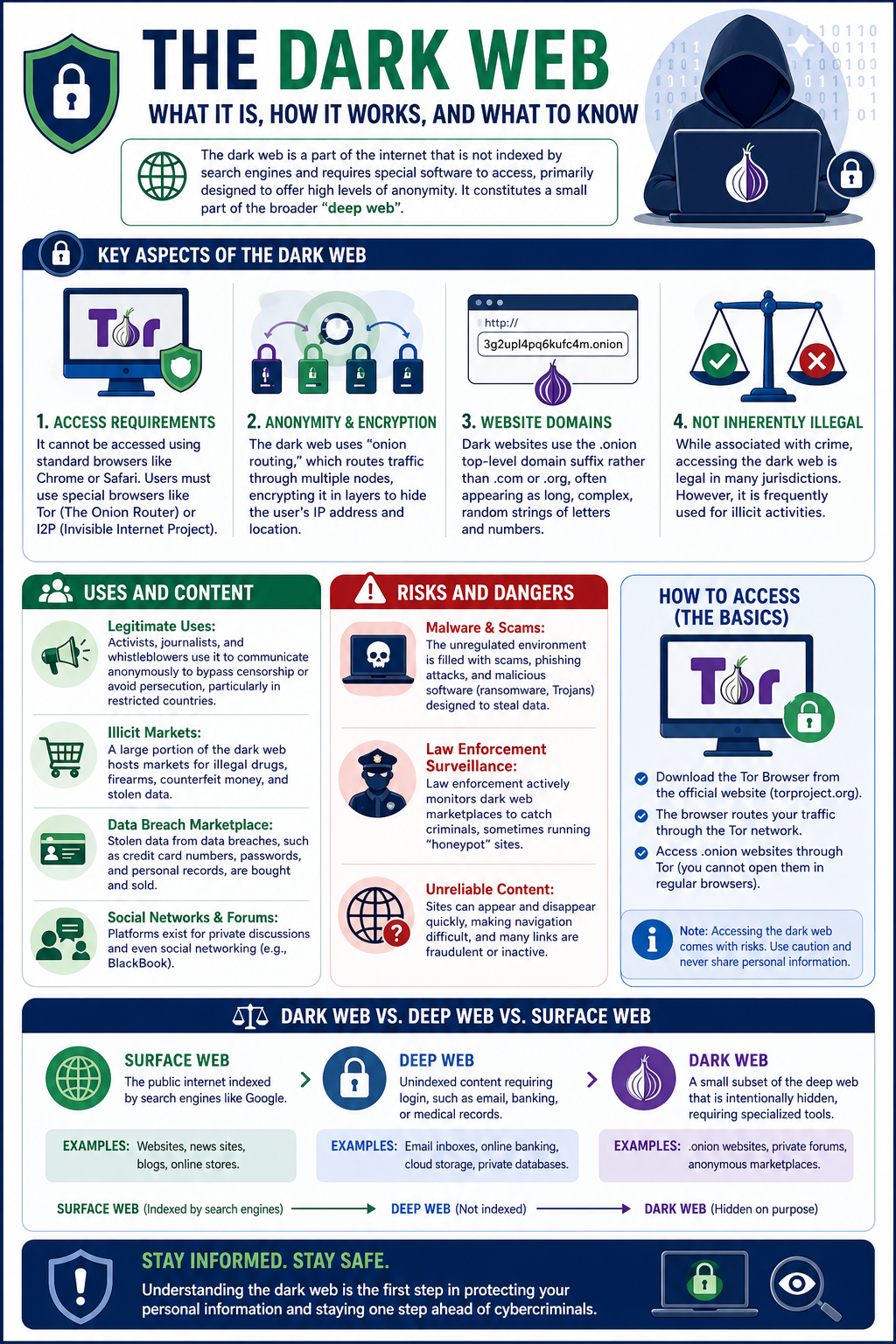
The dark web is a hidden part of the internet that requires special software to access and operates using encrypted networks to protect user anonymity. Unlike the regular internet you use every day, the dark web cannot be accessed through standard browsers like Chrome or Firefox, and its websites do not appear in search engine results.
It exists as a small but significant portion of what security experts call the "deep web" and serves as a marketplace, communication platform, and repository for both legitimate privacy-focused activities and illegal content.
Understanding the dark web matters for personal security because stolen personal information often ends up there for sale after data breaches. According to the Federal Trade Commission, there were more than 1.1 million reports of identity theft received through the FTC's IdentityTheft.gov website in 2024, and much of that compromised data eventually appears on dark web marketplaces where criminals buy and sell personal information.¹
The dark web represents approximately 5% of the total internet, according to Tulane’s research, but its impact on digital security affects millions of people whose data has been exposed in breaches and sold on hidden marketplaces.2
Key takeaways
- The dark web is a small, hidden portion of the internet (~5%) that requires special software like Tor Browser to access. It cannot be found through standard search engines.
- Accessing the dark web is technically legal in the United States, but many activities conducted there (such as the buying and selling of stolen data) are not.
- After data breaches, stolen personal information (Social Security numbers, credit card details, login credentials) frequently ends up for sale on dark web marketplaces within hours.
- Common warning signs your data may be on the dark web include unfamiliar accounts on your credit report, unexpected password reset emails, and bills for services you never used.
- Dark web monitoring services can alert you when your personal information appears in hidden marketplaces (giving you a critical head start in protecting your identity).
- Proactive steps like freezing your credit, using unique passwords, and enabling two-factor authentication can significantly reduce the damage if your data is exposed.
What is the dark web?
- Dark web
- The dark web is a collection of websites that exist on encrypted networks and require special software, configurations, or authorization to access.
The dark web forms a small part of the deep web, the part of the web not indexed by web search engines, and is distinct from both the surface web (regular websites) and the broader deep web (password-protected or unindexed content).
Most dark web activity occurs on the Tor network, which uses "onion routing" technology to encrypt and anonymize internet traffic. Tor uses onion routing to encrypt and reroute web traffic through Tor's onion network. After your data is secured inside multiple layers of encryption, your web traffic is transmitted through a series of network nodes, called onion routers.
The term "dark web" originates from the 1970s of computer science, when researchers described isolated networks unconnected to ARPANET (the internet's predecessor) as "darknets."³ Today, the dark web consists primarily of the Tor network, though smaller networks like I2P, Freenet, and peer-to-peer systems also exist.
Surface web vs. deep web vs. dark web
To understand the dark web, it helps to know where it fits in the broader internet structure:
Surface web: Regular websites accessible through standard browsers and indexed by search engines like Google. This represents the smallest portion of the internet.
Deep web: Content that exists online but is not indexed by search engines, including password-protected sites, private databases, internal company pages, and personal account information. This represents approximately 90% of all internet content.
Dark web: A subset of the deep web that requires special software to access and is intentionally hidden from standard web browsers. This represents roughly 5% of the total internet.
How does the dark web work?
The dark web functions through overlay networks that use the public internet infrastructure but add layers of encryption and routing to hide user identities and website locations.
The Tor network
The Tor network is comprised of thousands of volunteer-run servers known as Tor relays. When you use Tor to access the dark web, your internet traffic passes through multiple encrypted layers:
Entry node (Guard relay): The first relay in the circuit, which knows your real IP address but not your final destination.
Middle relay: One or more intermediate relays that know neither your identity nor your destination.
Exit node: The final relay that knows where your traffic is going but not where it came from.
Each router (or node) then "peels away" a layer of encryption until the data reaches its final destination, fully decrypted.⁴ This process gives Tor its name, "The Onion Router," because, like an onion, the encryption has multiple layers that are removed one at a time.
.onion websites
Dark web websites use .onion addresses instead of regular domain names.
Instead of ending in .com or .co, dark web websites end in .onion. These addresses appear as random strings of letters and numbers, such as "3g2upl4pq6kufc4m.onion" (DuckDuckGo's dark web address).
When an onion site sets up, it makes itself known to several randomly chosen servers in the Tor network: these are called introduction points.⁵ The site connects to these points (using a Tor circuit to keep anonymous) and provides them with its public key, which gives a way of identifying the service without giving its IP address.
What is on the dark web?
The dark web hosts a wide range of content, from legitimate privacy tools to illegal marketplaces. Research suggests that content breakdown varies, but understanding the categories helps explain why the dark web exists and why it concerns security experts.
Legitimate uses
Many people use the dark web for legal purposes:
Privacy protection: Journalists, activists, and political dissidents in authoritarian countries use the dark web to communicate safely and access uncensored information.
Whistleblowing platforms: Organizations like SecureDrop use dark web infrastructure to allow sources to share sensitive information with journalists anonymously.
Privacy-focused services: Legitimate versions of popular platforms, including Facebook's dark website, which, according to Roger Dingledine (one of the three founders of the Tor Project), Facebook is the biggest hidden service.
Research and education: Cybersecurity professionals, law enforcement, and researchers monitor dark web activity to understand emerging threats and criminal behavior.
Illegal marketplaces
Unfortunately, the dark web also hosts significant illegal activity:
Stolen personal information: Credit card numbers, Social Security numbers, login credentials, and identity packages sold by cybercriminals.
Drugs and weapons: Illegal substances and firearms sold through encrypted marketplaces.
Hacking services: Criminals offer services like distributed denial-of-service (DDoS) attacks, malware creation, and computer intrusion.
Counterfeit goods: Fake documents, currency, and branded products.
Your personal information on the dark web
Data from breaches frequently appears on dark web marketplaces. In 2024, the top three Sentinel report categories were Credit Bureaus and Information Furnishers (21% of all reports), Identity Theft (18%), and Imposter Scams (13%). When companies suffer data breaches, stolen records often end up for sale on dark web forums within hours or days.
The types of personal information commonly found include:
Social Security numbers
Credit card and banking information
Login credentials for email and financial accounts
Medical records and insurance information
Complete identity packages ("fullz") containing names, addresses, birthdates, and financial details
Find out if your personal information is already for sale
OmniWatch monitors dark web marketplaces, breach databases, and hidden forums around the clock. You’ll be alerted the moment your data surfaces so you can protect yourself before the damage starts.
Start dark web monitoring with OmniWatchHow to access the dark web safely (if needed)
If you have legitimate reasons to access the dark web, such as research or journalism, follow these safety precautions:
Required software
Tor Browser: Download only from the official Tor Project website (torproject.org). Tor Browser is a modified version of Firefox designed to connect to the Tor network.
VPN (recommended): Use a reputable VPN service before connecting to Tor to add an extra layer of privacy and hide Tor usage from your internet service provider.
Essential safety measures
Never download files: Dark web sites may contain malware designed to compromise your computer or reveal your identity.
Use a separate device: Consider accessing the dark web from a dedicated computer or virtual machine that contains no personal information.
Disable JavaScript: Keep JavaScript disabled in Tor Browser to prevent potential security vulnerabilities.
Never provide personal information: Do not enter real names, email addresses, or any identifying information on dark websites.
Use Tails OS: For maximum security, some users boot from the Tails operating system, which routes all traffic through Tor and leaves no traces on the host computer.
What not to do
Never make purchases: Engaging in any commercial activity on dark web marketplaces is illegal and dangerous.
Don't access illegal content: Viewing, downloading, or sharing illegal material can result in serious criminal charges.
Avoid clicking unknown links: Dark web sites frequently contain scams, malware, or law enforcement traps.
Don't attempt to identify others: Trying to unmask other users violates the network's purpose and could expose you to retaliation.
Why the dark web matters for your security
Even if you never access the dark web directly, it affects your digital security because stolen personal information ends up there after data breaches.
Data breaches and the dark web
Consumers reported losing more than $12.5 billion to fraud in 2024, which represents a 25% increase over the prior year.¹ Much of this fraud begins with personal information sold on dark web marketplaces.
The process typically works like this:
Company suffers a data breach: Hackers infiltrate business databases and steal customer records
Data gets packaged and sold: Criminals organize stolen information by type and value
Buyers use data for fraud: Purchasers use the information for identity theft, account takeover, or other crimes
Victims discover the damage: Often weeks or months later, victims notice unauthorized accounts, charges, or credit problems
Common warning signs your data may be on the dark web
Unfamiliar accounts or credit inquiries on your credit reports
Unexpected emails about password resets for accounts you didn't request
Bills or collection notices for services you never used
Rejection of tax returns because someone has already filed using your Social Security number
Medical insurance statements for care you never received
Protecting yourself from dark web threats
Since you cannot control whether companies holding your data will be breached, focus on limiting damage when breaches occur:
Immediate protective steps
Freeze your credit: Place security freezes at all three major credit bureaus (Equifax, Experian, TransUnion) to prevent new accounts from being opened in your name.
Enable two-factor authentication: Add extra security layers to important accounts, especially email and financial services.
Monitor your accounts: Check bank and credit card statements regularly for unauthorized transactions.
Use unique, strong passwords: Never reuse passwords across multiple accounts, and consider a password manager to generate and store complex credentials.
Ongoing monitoring
Credit monitoring: Set up alerts to notify you immediately when new accounts, inquiries, or changes appear on your credit reports.
Dark web monitoring: Services that scan dark web marketplaces for your personal information can provide early warnings when your data appears for sale.
Identity theft protection: Comprehensive services combine monitoring, insurance, and restoration assistance to address identity theft quickly when it occurs.
OmniWatch's identity protection services include dark web monitoring, credit alerts, and plans with up to $4 million in identity theft insurance to help you respond quickly when threats emerge.
Dark web myths vs. reality
Myth: The dark web is entirely illegal
Reality: While the dark web hosts significant illegal activity, it also serves legitimate purposes, including privacy protection, journalism, and research. Accessing the dark web itself is legal in most countries.
Myth: Law enforcement cannot track dark web users
Reality: Despite the anonymity provided by Tor, law enforcement agencies have successfully identified and prosecuted dark web criminals through various investigative techniques, operational security failures, and international cooperation.
Myth: The dark web is massive
Reality: The dark web comprises only 3% of the traffic in the Tor network.⁶ Most Tor usage involves people accessing regular websites with enhanced privacy rather than visiting hidden services.
Myth: You need special skills to access the dark web
Reality: Accessing the dark web requires only downloading Tor Browser, though doing so safely requires understanding the security implications and taking appropriate precautions.
Myth: Everything on the dark web is expensive
Reality: Stolen personal information sells for surprisingly low prices. Social Security numbers may cost as little as $1-10, while complete identity packages range from $16-228, depending on the victim's financial profile.
The future of the dark web
Several trends are shaping how the dark web operates and its impact on cybersecurity:
Law enforcement efforts
Authorities continue developing techniques to disrupt dark web marketplaces and identify users involved in illegal activities. Major operations have shut down prominent marketplaces, though new ones typically emerge quickly.
Cryptocurrency evolution
Bitcoin has been a major factor in the growth of the dark web, and the dark web has been a big factor in the growth of bitcoin. As cryptocurrency regulation increases and privacy coins develop, the financial infrastructure supporting dark web commerce continues evolving.
Artificial intelligence threats
Criminal use of AI for creating deepfakes, automating attacks, and enhancing social engineering represents an emerging threat that could increase the volume and sophistication of crimes facilitated by dark web infrastructure.
Enhanced privacy tools
As surveillance concerns grow, more legitimate users may turn to privacy-enhancing tools, potentially increasing overall dark web traffic and making it harder to distinguish between legal and illegal activity.
Don't wait to find out the hard way
OmniWatch gives you continuous dark web monitoring, real-time credit alerts, and plans with up to $4 million in identity theft insurance.
Explore OmniWatch protection plansFrequently asked questions
Is it illegal to access the dark web?
How do I know if my personal information is on the dark web?
Can police track people on the dark web?
What's the difference between the dark web and the deep web?
Should I use a VPN with Tor?
Why does stolen personal information end up on the dark web?
This guide is published by OmniWatch. Follow OmniWatch on Facebook for ongoing guidance on identity protection, digital safety, and scam awareness.
¹ Federal Trade Commission, New FTC Data Show a Big Jump in Reported Losses to Fraud to $12.5 Billion in 2024, 2025
² Tulane University, Everything You Should Know About the Dark Web
³ Wikipedia, Dark web, 2026
⁴ Avast, The Dark Web Browser: What Is Tor, Is it Safe, and How Do You Use It?, 2024
⁵ The Tor Project, Privacy & Freedom Online, 2026
6 CSO Online, What is the dark web? How to access it and what you'll find, 2025