
 Call us at (877) 892-8249


Yes, identity theft can badly damage your credit, but the harm is almost always reversible. When a thief opens new accounts in your name, runs up balances, or lets fraudulent accounts fall into default, those actions strike the parts of a credit score that matter most: payment history, amounts owed and new credit. That is why victims of financial identity theft can see sharp score drops.¹ The damage is rarely permanent, though. Federal law gives victims the right to block and remove fraudulent information, and scores often rebound once the fraudulent items are corrected.
The real variable is time. How much a score falls, and how quickly it recovers, depends mostly on how fast the fraud is caught. This guide explains the specific ways identity theft harms credit, which forms of fraud do the most damage, and the steps that repair a score and protect it going forward.
Key takeaways
- Identity theft can lower a credit score significantly, but the damage is almost always reversible.¹
- New-account fraud is the most damaging type, because it hits payment history, credit utilization, and new-credit factors at once.
- New-account fraud is also growing fast. Javelin's 2026 study reported 5.4 million victims in 2025, up from 4.2 million the year before.²
- Federal law lets victims block and remove fraudulent accounts using an official Identity Theft Report.³
- A credit freeze is free, and it does not lower your credit score.
- Speed of detection is the single biggest factor in how far a score falls and how fast it recovers.
How identity theft damages a credit score
Your credit score is based on a few key factors, and identity theft can hurt several of them at once. Knowing how it works makes the damage less mysterious and the fix easier to follow.
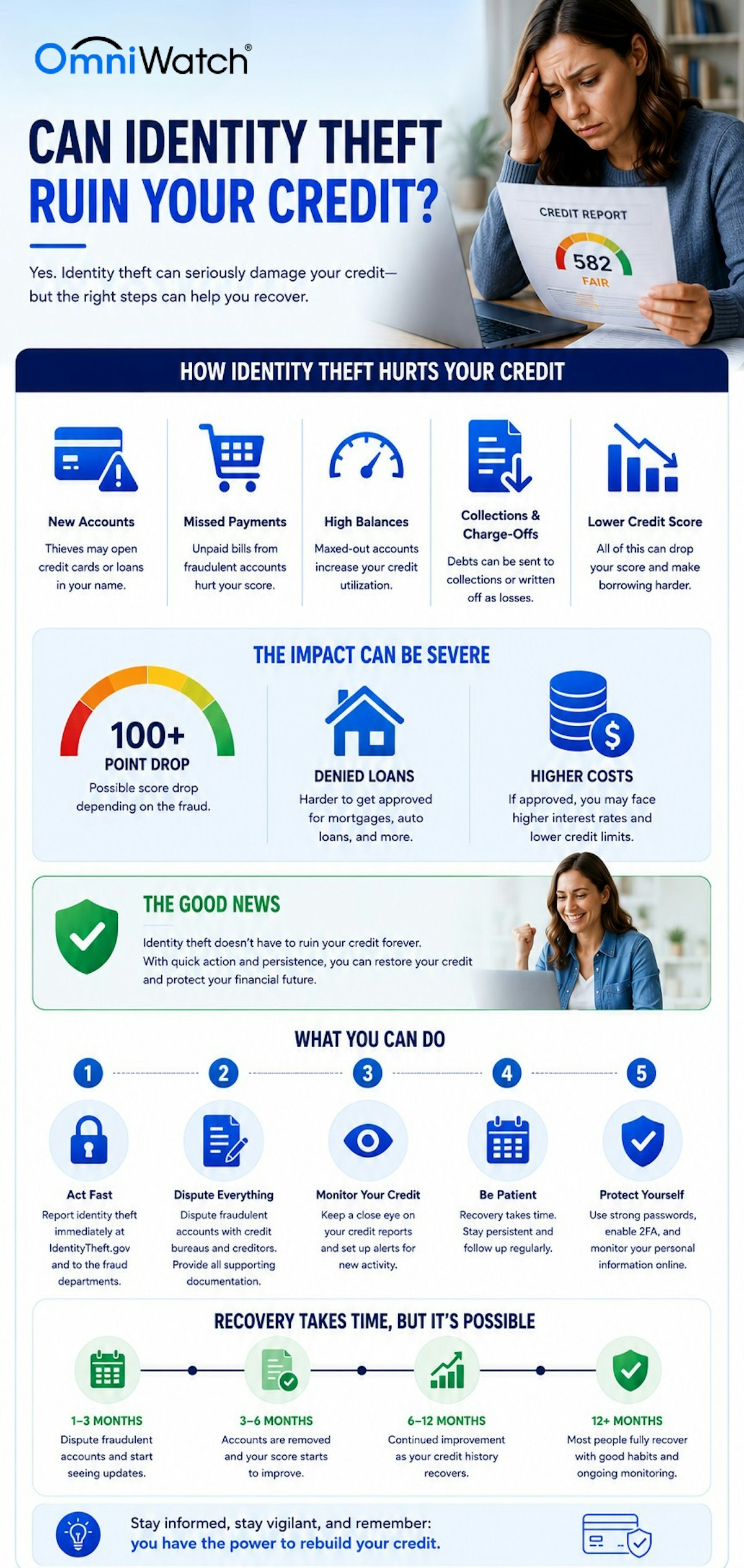
Payment history usually takes the biggest hit, since it’s the largest part of most credit scores. When a thief opens an account and never pays it, the missed payments and eventual default are reported as yours, dragging your credit score down.
Amounts owed suffer next. A fraudulent card maxed out to its limit can make you look like you’re using most of your available credit, which scoring models read as a sign of financial strain.
New credit is a third pressure point. Every fraudulent application triggers a hard inquiry (a check on your credit report), and thieves often apply for several accounts in a short window. Each inquiry can shave off a few points.
Collections is the fourth blow. When fraudulent accounts go unpaid, they’re often sold to collection agencies, which adds negative marks to your report that can stay there for years. All of these can be reversed once the accounts are proven fraudulent, but together they show how a single theft can pull a score down fast.
How exposed is your personal information?
Take our free risk quiz to see where your data may be exposed online.
Take the Risk Quiz
Which types of identity theft hurt credit most
Not every form of identity theft touches your credit, and the ones that do vary widely in severity. Separating them clarifies where the real danger to a score lies.
New-account fraud is the most damaging by a wide margin. Because it plants an entire fake account on your file, it can affect payment history, utilization, and new-credit inquiries simultaneously. This category is also the most common and the fastest-growing. Financial identity theft accounts for more than 40% of all reported cases, and credit card fraud alone generated over 450,000 reports in a single recent year, the majority of them tied to newly opened accounts rather than stolen existing cards.¹
Existing-account fraud, such as unauthorized charges on a card you already hold, is far less harmful to credit. It is usually resolved through a chargeback within a billing cycle and rarely reaches your credit report at all. Other forms, including medical identity theft and tax-related fraud, can cause serious problems but often sit outside the credit file entirely, which is why they can go undetected for so long. Recognizing the signs of identity theft early is what keeps a new-account case from compounding.
How bad can the damage get?
The size of a credit hit depends on how many fraudulent accounts appear, how long they go unpaid, and how quickly the fraud is discovered. A single hard inquiry might cost only a few points, while a defaulted fraudulent loan sent to collections can cause a substantial drop.
And the scale of exposure is growing. Javelin's 2026 study found that new-account fraud, the type most likely to wreck a credit file, reached 5.4 million victims in 2025, a jump of nearly a third from 4.2 million the prior year.² That growth traces back to the volume of stolen data in circulation. The Identity Theft Resource Center tracked a record 3,322 data compromises in 2025, and breaches exposing Social Security numbers have climbed sharply, giving criminals the durable identifiers they need to open credit in someone else's name.⁴
The encouraging counterpoint is that severity and duration move together. A fraudulent account caught within weeks and disputed promptly does limited, recoverable harm. The same account left unnoticed for months can accumulate missed payments and collections entries that take far longer to clear. The size of the damage is largely a function of how long the fraud is allowed to run.
Why the damage is usually reversible
The most important thing to understand about identity theft and credit is that the harm is treatable. Consumers have strong legal tools to force fraudulent information off their reports, and scores recover once that information is gone.
The central tool is the official Identity Theft Report, filed at IdentityTheft.gov, the federal government's official recovery site.³ That report compels credit bureaus and creditors to block and remove accounts opened through fraud. Under the Fair Credit Reporting Act, bureaus must investigate disputed information and correct or delete anything inaccurate, and a valid Identity Theft Report strengthens that obligation.
Removal is what actually restores the score. Once a fraudulent account is deleted, the missed payments, inflated utilization, and hard inquiry tied to it come off with it, and the score typically climbs back toward its prior level.
Persistence matters here, because an account that keeps reappearing after a dispute can depress a score for months. You can pull your reports for free at AnnualCreditReport.com to confirm the fraudulent entries are truly gone. To catch new problems sooner, OmniWatch identity theft protection monitors your credit, alerts you to new accounts and inquiries, and connects you with restoration agents who can help with disputes and paperwork.
Identity theft can hurt your credit, but the law gives you tools to undo it.
Stay safe with identity theft protection
OmniWatch provides dark web and Social Security number monitoring, identity theft protection with up to $4 million in identity theft insurance,* and restoration support to help resolve identity theft.
Identity Theft ProtectionHow long does credit take to recover?
Recovery timelines follow the same logic as the damage itself. The faster the fraud is caught and documented, the faster the score rebounds.
When fraud is detected within the first few weeks, the effects are often limited to a hard inquiry and a brief utilization spike, both of which fade within a month or two of correction. When fraud runs for 90 days or more, delinquency marks and collections entries enter the picture, and clearing them across creditors and all three bureaus can take several months of disputes. Complex cases involving multiple fraudulent accounts naturally sit at the longer end.
Two habits shorten the timeline more than anything else.
The first is early detection, which keeps a case in the quick-recovery range. The second is thorough documentation, since organized records and a filed Identity Theft Report are what make bureaus and creditors act. Ongoing credit monitoring supports the first habit by flagging new accounts and inquiries, often before a statement arrives.
How to protect and rebuild your credit
Whether you are recovering from fraud or trying to prevent it, the same short list of actions does most of the protective work for a credit file.
Place a credit freeze at all three bureaus. It blocks new accounts from being opened; it is free, and it does not lower your score.
File an Identity Theft Report at IdentityTheft.gov if fraud has already occurred, then use it to dispute every fraudulent item.
Review your credit reports regularly at AnnualCreditReport.com and flag anything you do not recognize.
Monitor your credit and identity so new accounts, inquiries, and score changes surface early.
Watch for exposure at the source, since most credit fraud begins with a data breach long before an account is opened.
Most credit fraud starts with stolen data that circulates on hidden marketplaces before anyone uses it, so spotting exposure early gives you a head start. Dark web monitoring can alert you when your information turns up, and our guide to the dark web explains how those marketplaces work. To lower your risk further, follow our checklist on how to prevent identity theft. And OmniWatch identity theft protection brings together monitoring, credit freezes, and restoration support, so you can limit the damage to your credit if something does get through.
Frequently asked questions
Can identity theft ruin your credit permanently?
No. It can cause a sharp, temporary drop, but federal law lets you block and remove fraudulent accounts, and scores generally recover once those items are corrected.
How much can identity theft lower a credit score?
It varies with the fraud. A single hard inquiry costs only a few points, while a defaulted fraudulent account sent to collections can cause a large drop.
Which type of identity theft damages credit the most?
New-account fraud, because it can hit payment history, credit utilization, and new-credit inquiries at the same time.
Does a credit freeze hurt my credit score?
No. A freeze blocks new accounts from being opened in your name; it is free at all three bureaus, and it has no effect on your score.
How do I remove fraudulent accounts from my credit report?
File an official Identity Theft Report at IdentityTheft.gov, then dispute each fraudulent item with the credit bureaus, which are required to investigate and correct inaccurate information.
How long until my credit recovers after identity theft?
Often one to two months for cases caught early, and several months for cases involving delinquencies or collections that must be disputed across bureaus.

This guide is published by OmniWatch. Follow OmniWatch on Facebook for ongoing guidance on identity protection, digital safety, and scam awareness.
Sources
Security.org, "Identity Theft Statistics in 2026: Looking Into America's Fastest-Growing Crime," 2026. https://www.security.org/identity-theft/statistics/
Javelin Strategy and Research, 2026 Identity Fraud Study. https://www.javelinstrategy.com/
IdentityTheft.gov, official identity theft recovery program and recovery plan. https://www.identitytheft.gov/
Identity Theft Resource Center, 2025 Annual Data Breach Report, January 2026. https://www.idtheftcenter.org/post/2025-annual-data-breach-report-record-number-compromises/
Federal Bureau of Investigation, Internet Crime Complaint Center (IC3), 2025 Internet Crime Report, April 2026. https://www.ic3.gov/AnnualReport/Reports/2025_IC3Report.pdf