
 Call us at (877) 892-8249
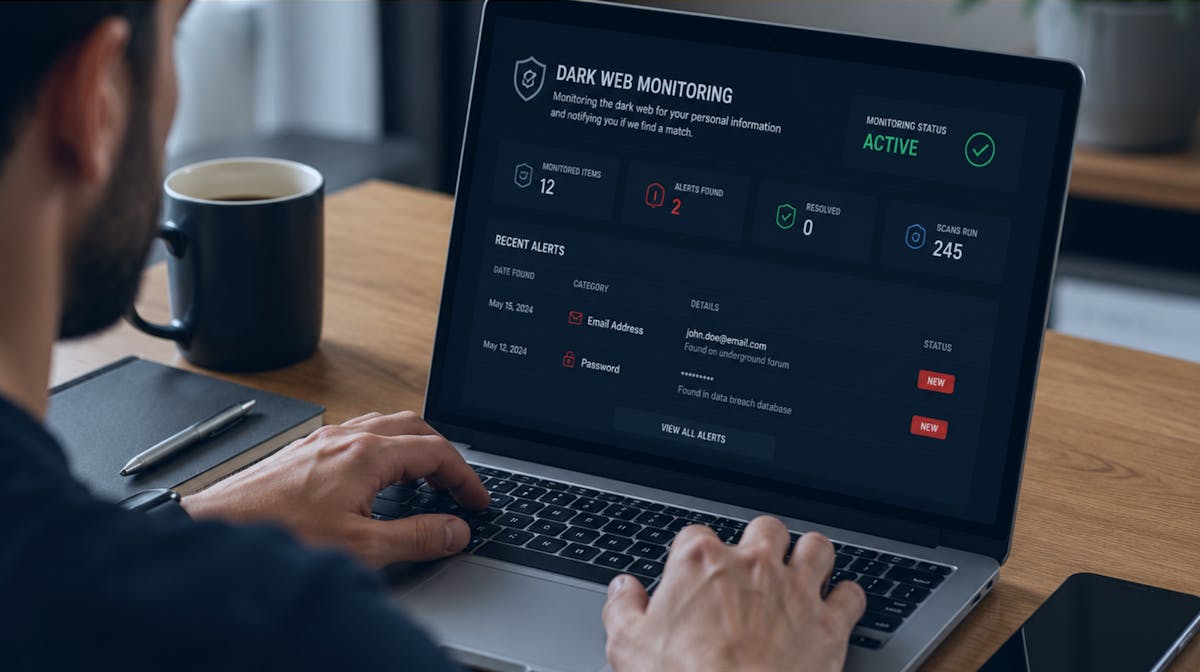
Dark web monitoring is a security service that continuously scans the dark web and breach databases for your personal information, then alerts you the moment it appears so you can secure your accounts before criminals use the data. It does not remove your data from the dark web, and it cannot prevent the breaches that put it there. What it does is close the gap between the moment your information is exposed and the moment you find out, which is often the difference between a quick password change and months of fraud recovery.
Below, we cover exactly what dark web monitoring watches for, how the alerts are generated, what the technology can and cannot do, and how it fits alongside credit monitoring and other identity protections.
What dark web monitoring actually does
- dark web
- The dark web is a small, encrypted portion of the internet that standard browsers cannot reach and search engines do not index. It accounts for roughly 5% of the total internet, yet it functions as one of the primary distribution channels for stolen personal data. (For a deeper explanation, see our guide on what the dark web is.)
Monitoring services work by maintaining and continuously checking large repositories of leaked and stolen records. When a company is breached, the stolen database is often sorted, packaged, and listed for sale on dark web forums and marketplaces within hours. A monitoring tool compares the identifiers you have asked it to watch, such as your email address or Social Security number, against that flow of newly surfaced data. When it finds a match, it sends an alert.
One of the biggest things monitoring buys you is time. Most fraud begins quietly, and many victims do not notice anything until a charge appears, a credit application is denied, or a tax return is rejected. An alert that your data has surfaced gives you a window to act before that damage starts.
How dark web monitoring works, step by step
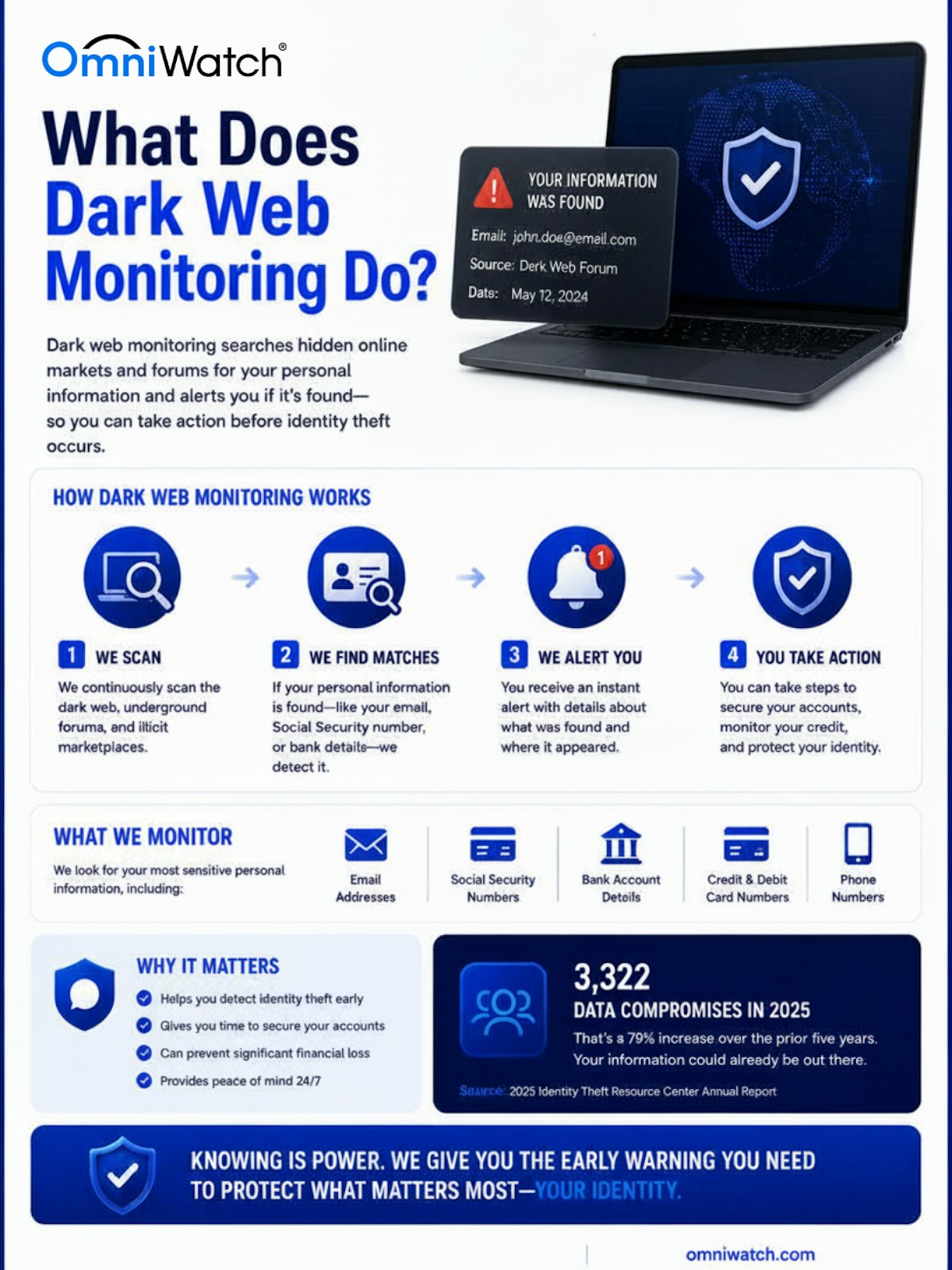
Breaking it down into stages makes it easier to see what’s actually happening. OmniWatch’s dark web monitoring follows a three-part process:
Check verified sources. The service matches your email address and other personal identifiers like Social Security numbers against a database of known breaches, leak sites, and marketplace listings.
See what is exposed. If there is a match, you are shown the breach name, the date, and the specific type of data that was compromised, rather than a vague warning.
Get next steps. You receive a clear alert with the actions that reduce harm, such as updating passwords, enabling two-factor authentication, and freezing credit where appropriate.
The last step is the most crucial. An alert that a Social Security number appeared in a forum only helps someone who already knows what to do next, which is why we pair every alert with specific guidance.
What information does dark web monitoring look for?
Your email address and password are just the beginning. Modern fraud is assembled from many small pieces of data: a Social Security number from one breach, a bank account number from another. OmniWatch monitors more than 130 categories of personal information, including:
Social Security numbers and other government identifiers
Bank account and credit card numbers
Login credentials and passwords
Phone numbers and email addresses
Driver's license and passport numbers
Medical and insurance identifiers
On dark web marketplaces, a single Social Security number can sell for as little as $1 to $10, while a complete identity package, sometimes called a "fullz," can range from roughly $200 to $100, depending on the financial profile of the victim. Criminals buy what they need, combine it, and use it to open accounts, file fraudulent tax claims, or take over existing logins.1
Why your data ends up on the dark web
Your data doesn’t end up on the dark web by accident. The most common path is a corporate data breach. You can follow good security habits and still have your information leaked when a company that holds your data is compromised.
The scale of this problem set a record last year. The Identity Theft Resource Center tracked 3,322 data compromises in 2025, the highest annual total it has ever recorded and a 79% increase over five years. The same report noted a clear shift in what criminals target: compromises involving Social Security numbers nearly doubled over the period, reaching 2,236, and breaches exposing bank account details climbed to 1,099 as attackers prioritized durable identifiers that enable long-term fraud rather than easily replaced card numbers.2
Breaches are not the only source. Data also reaches the dark web through phishing messages, malware installed on a device, and brokers who aggregate and resell personal information. The sheer volume of online activity that involves sharing personal and payment data, from banking apps to everyday retail checkouts, widens the surface area that criminals can eventually exploit.
What dark web monitoring can and cannot do
It helps to know exactly what monitoring can and can’t do. Dark web monitoring does one thing exceptionally well, but it’s helpful to know what its limitations are.
What it can do is detect exposed data quickly, identify which breach it came from, and prompt timely defensive action. Catching an exposure early lets you change a reused password before it unlocks other accounts or freeze your credit before a new line is opened in your name.
What it cannot do is remove your information from the dark web. Once data is leaked, it is copied and stored countless times across servers that no one controls, so deletion is not possible. The realistic objective is to make the stolen data useless by changing the associated passwords, freezing accounts, and adding authentication barriers. Monitoring also cannot stop a breach from happening at the company that holds your data, and it is not a substitute for basic security hygiene.
Searching the dark web yourself is also not a practical alternative. Doing so can expose your device to malware, and most stolen records are traded on private forums that casual users cannot reach. Automated monitoring is both safer and far more comprehensive.
What to do when you receive a dark web alert
An alert is a prompt to act, not a cause for panic. What you do next depends on what was exposed, but a few steps apply almost every time.
Change the password for the affected account and for any other account where you reused it.
Turn on two-factor authentication for email, banking, and any financial logins.
If a Social Security number or financial identifier was exposed, freeze your credit with Experian, Equifax, and TransUnion. A freeze is free and prevents new accounts from being opened without your authorization.
Watch your financial statements and credit reports for unfamiliar activity over the following weeks.
How dark web monitoring fits into broader identity protection
Dark web monitoring addresses one stage of a longer timeline. It detects exposure, but exposure is only the beginning of how fraud unfolds, and the financial stakes have grown sharply.
+26%
The FBI's Internet Crime Complaint Center logged more than 1 million complaints in 2025, with reported losses exceeding $20.9 billion, a 26% increase over the prior year and an average reported loss of $20,699 per incident.
Personal data breaches ranked among the most reported cyber threats in that data, and the report tracked artificial-intelligence-enabled fraud as its own category for the first time, with 22,364 complaints and nearly $893 million in losses.3
That landscape explains why monitoring is usually one layer in a larger system. A complete identity theft protection typically combines dark web and credit monitoring for early detection, restoration support to undo damage after theft occurs, and insurance to offset the financial and administrative costs of recovery. Because more losses now come from social engineering (like a scam or deceptive message) rather than stolen credentials alone, scam protection tools that flag phishing and fraudulent messages address a channel that breach-based monitoring does not reach. Together, they cover both the data that has already leaked and the active attempts to deceive you.
Is dark web monitoring worth it?
For most people, yes. The cost of proactive monitoring is small compared with the time and money required to recover from identity theft, and the early warning it provides is difficult to replicate on your own. Think of it as an alarm system that tells you when your information has surfaced, paired with guidance on what to do about it. It is not a vault that keeps data from leaking, and it does not replace freezing your credit or using strong, unique passwords.
The reality is that breaches are a near certainty over a lifetime of online activity, so the real question is not whether your data will be exposed, but how quickly you will know. Monitoring shortens that answer from months to minutes.
Frequently asked questions
Is dark web monitoring really worth it?
Can I just search the dark web myself?
What should I do if my Social Security number is on the dark web?
How does my information get on the dark web?
Can my data be removed from the dark web?
This guide is published by OmniWatch. Follow OmniWatch on Facebook for ongoing guidance on identity protection, digital safety, and scam awareness.
1 Deepstrike, Dark Web Data Pricing 2025, 2025
2 Identity Theft Resource Center, 2025 Annual Data Breach Report, January 2026.
3 Federal Bureau of Investigation, Internet Crime Complaint Center (IC3), 2025 Internet Crime Report, April 2026.